Monday, 18 March 2019

It's the unexpected treasures that make TEFAF Maastricht the fair not to miss


 There are neither direct flights nor trains to Maastricht from London, Paris, Brussels or more distant points, unless of course you have a private jet. Enough of the latter turn up to cause a no parking sign to go up at its small airport. Yet TEFAF, which takes place in March every year, is unquestionably worth the trek to this town in the far east of the Netherlands where it borders Germany and Belgium.  It is not only the biggest and best art and antiques fair, it is like a giant treasure hunt; you just never know what work or object of art is going to reveal itself and send shock waves from head to toe.
   During last week's VVIP preview and indeed on the mere VIP preview the following day, I spent many million euros. The number would be far higher if more dealers were willing to tell me (a journalist) their prices. True my purchases (like the sums needed to take them home) exist only in my mind but happily I find so much food for hungry eyes a lavish banquet.
   TEFAF's fame was built on the number and quality of Old Master paintings its dealers offered but these days there are many fewer top quality Old Masters on the market anywhere. Yet even in this category I was beguiled.
   "Portrait of a Dog," by the Florentine painter Tiberio Titi  (1578-1627) is a honey. This is no generic hound; no dutiful execution of a plump commission. It is a closely observed, beautifully painted portrait of an arresting, highly individual, living creature that happens to be canine. Okay I am doggie as the English call it and some might say also a little on the offbeat side. These are facts not explanations for why I wanted to buy this painting. And doubters note: Standing next to me in the stand of Paris dealer Maurizio Canesso and also taking photos of this Titi portrait, was Eike Schmidt, Director of the Uffizi Gallery in Florence. We soon were chatting about other memorable dog portraits; he mentioned Giulio Romano, I was think of Paulus Potter.  


Here are a few of the other surprise treats I gobbled up at the fair:
 At the stand of Buenos Aires dealer Jaime Eguiguren-Arte y Antiguedades I was transfixed by five small caskets of a type I'd never seen before. These little 17th century chests were made in Colombia during the Spanish Conquest. 
The rarest of these rarities (above) is inlaid with gold. All five of the little caskets are made with a technique that was inspired by the luxurious, mother of pearl inlaid Namban- ware made in Japan at around the same time when the Portuguese were allowed there to trade.  These are made with less luxurious materials and some are less technically sophisticated. In Colombia they used what they had; plant dyes and pastes filled in the incised designs. The results however are beautiful even joyful and now rare. 


At the stand of Ab-PAB, Paris- based dealers in Spanish and Portuguese Colonial art, ivory turned into a magnetic material as I was drawn across the stand to the vitrine in which stood the little sculpture below.  They date it to the 17th century. I assumed it was from Goa (where the Portuguese had a flourishing trading post). I learned that, most unusually, it was carved in Thailand. Its subject is the young John the Baptist with his playmate the infant Jesus represented by a lamb. After all, the Baptist is often portrayed dressed in an animal skin and here were not one a single lamb but two. The dealers disagree. They label this a statue of the infant Jesus as the Good Shepherd. I remain unconvinced if also aware of my ignorance--and sigh, wishing the price was not 9,000 euros. 


For an absolute killer chandelier with not a crystal drop in sight, a hugely oversized hidden treasure, is the magnificent metal artichoke chandelier at Brussels dealer Yves Maccou. "You need a room with a very high ceiling," he warned me, adding that its price is about 350,000 euros. Ruled out on both counts. 
 
On Friday morning, my third day in town, I went to the weekly market to buy tulips and cheese (more my price range). It was cold, gray, raining, Dismal weather which seemed fitting as I looked up at the impressive State House that faces the square. It was here, in 1993 that representative of the member nations gathered to sign the treaty which established the European Union--the treaty that back home in London politicians were so chaotically attempting to unravel. It was a relief as well as a pleasure to head back to TEFAF and the abundant evidence that for many centuries men and women have been creating wonders for all of us to enjoy.

Friday, 5 October 2018

Where there's smoke: Did Henry VIII's--and the nation's-- treasure leave England illegally?


The magnificent St Paul tapestry commissioned by Henry VIII for Hampton Court Palace in 1536 is a  national treasure. It was taken from London to Barcelona in the late 1960s and has remained in Spain ever since. Why was such an exceptional treasure given a license to leave this country?  The answer, it appears, is that it did not have one; that was exported illegally.  Splendid, historically important and technically innovative, the panel is currently back in London.  Spain granted its private owner a temporary license so that conservation work could be carried out by specialist dealers S Franses. They have put in on public view for the next two weeks. The final stage of conservation will then begin. The Spanish temporary license expires in February. By every relevant measures of importance, the St Paul tapestry belongs here. It should in England where it could join the National Collection at the Victoria & Albert Museum or, better still,  hang once again at Hampton Court.

Some 20-feet long, woven during the Renaissance in Brussels at the height of weavers’ skills, richly embellished with gold-wrapped thread, it is a fabulous piece that only a king could afford.  This surely was obvious to the Vigo-Sternberg-Galleries, top dealers in tapestries, where the work was seen shortly before it arrived in Spain. Its money value in 1970 was least $8,000, an additional reason an export license would have been required. (Today, on the open international market, it would be £10million or more.)  Indeed, its evident splendour and value is one reason that more recently, Spain has twice refused its owner’s application for a full export license. This far no  record that a license was requested or issued has turned up. According to the S Franses Gallery,  Wendy Hefford, tapestry specialist at the V& A when it left England and the expert most likely to be asked to judge its suitability for export, says she never saw it.    

This St Paul panel  is the  “It is the Holy Grail of Tudor Tapestries,” says Thomas P. Campbell, a former director of the Metropolitan Museum of Art and leading authority on Renaissance tapestries;  author of the brilliantly researched “Henry VIII and the Art of Majesty: Tapestries at the Tudor Court.” Originally there were nine tapestries in the St Paul set. This rare survival, all on its own, gives a vivid pictorial expression of the king’s thinking and state of mind at a tumultuous period in his reign and the country’s history--the dissolution of the monasteries.

Campbell explains that Henry VIII wished to  “present himself as head of the British church,  a religious man. He wanted to show that he was in direct succession to Abraham, Joshua, David, Moses and St. Paul.”  In this work St Paul is shown directing the burning of irreligious texts; an act  Henry VIII was then overseeing in England.  The smoke that billows up in the centre of the tapestry—wonderful and terrible-- is evidence of destruction in the service of religion and power. It is also an aesthetic and technical triumph. Go see it at the gallery. With any luck it will remain at home in England for all to see in years to come.


Tomorrow (Saturday) Campbell will be giving a lecture on Henry VIII's tapestry collection at the Royal Academy of Art. (Tickets, which are free, are available through the Franses gallery..)   


Saturday, 25 August 2018

Priceless Freedom: The photographs of Pentti Sammallahti

Pentti Sammallahti


https://www.1stdibs.com/introspective-magazine/pentti-sammallahti


Please click on the link above to my this story abotu Pentti Sammallahti a great photographer.


Saturday, 28 July 2018

https://www.economist.com/books-and-arts/2018/07/28/pentti-sammallahti-finlands-top-photographer

This my most recent story is readable by going to Economist.com and then if you are not a subscriber, registering. There is no obligation to subscribe and you get three free stories a month.
MAKE THIS ONE OF THEM! Pentti Sammallahti is a photographer whose work you might like--a lot.

Sunday, 24 June 2018

Heavenly Bodies: fun but no soul


Rocking frocks

“Heavenly Bodies” mixes metaphors at the Met

Its curators hope that the blend of high-fashion and RomanCatholic artefacts is “simply divine”. But divinity is not so simple

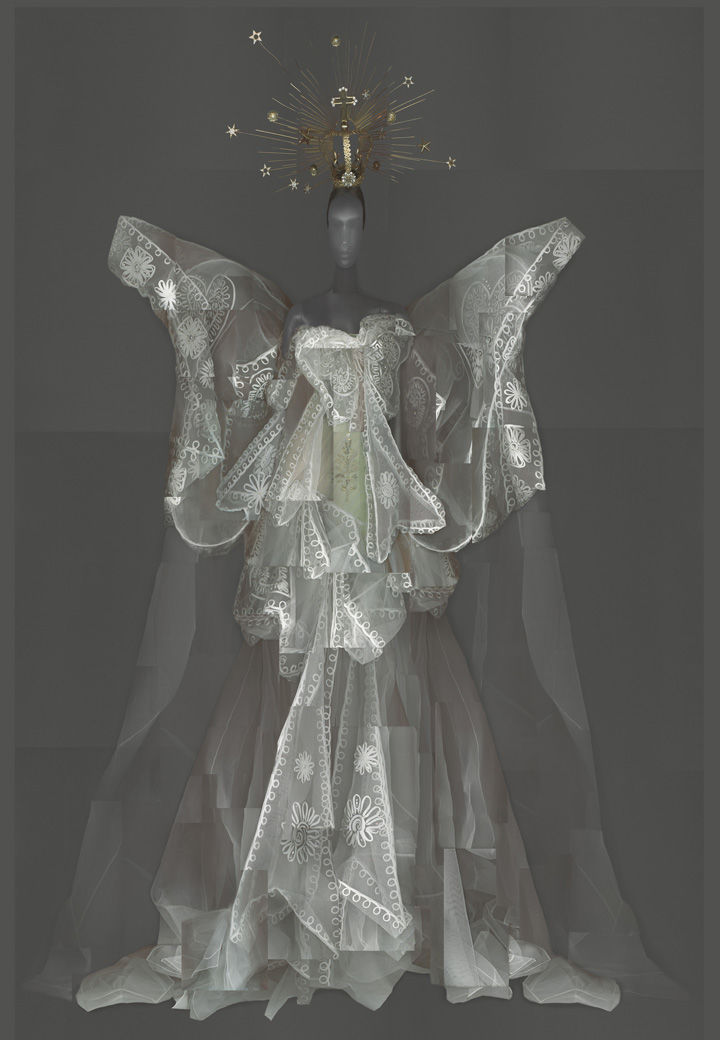
John Galliano evening ensemble inspired by an angel's white robes and glowing halo
Prospero
May 24th 2018by P.W. | NEW YORK

TWO diverging meanings of “divine” underpin “Heavenly Bodies: Fashion and the Catholic Imagination”, at the Metropolitan Museum ofArt. This, the largest show in the history of the Met’s Costume Institute, and one of the biggest at the Met overall, is in large part “just divine, dahling,”—an exuberant and luscious treat. In contrast, the rare loan of some 40 ecclesiastical garments and objects from the Sistine Chapel Sacristy at the Vatican—all “dedicated to worship”—are divine in the traditional sense. To unite these two meanings is the goal of Andrew Bolton, the exhibition’s curator.

The hint that this was an over-reaching ambition was there from the start, with the organiser’s repeated references to taking a tour of the show as going on a “pilgrimage”. Of course the two meanings of divine can merge, and often do, when High Mass in performed in a magnificent cathedral, for example. Other denominations can achieve this, too, as was evident in Windsor at the royal wedding. “Heavenly Bodies” is drawing crowds for good reasons. The show’s production values alone are sensational, with columns of mannequins in golden dresses hanging suspended from the museum’s high ceilings and a very great deal more. But it never does quite marry the two divines. The Vatican loans include the silk- and gold-embroidered mantle of Pope BenedictXV; the embroidered and gem-embellished mitre of Pope Leo XIII; papal rings and pectoral crosses; and most extravagant of all, the tiara first worn by PopePius IX for Christmas mass at Saint Peter’s Basilica in Rome in 1854. It is set with 19,000 precious stones, most believed to be diamonds. More down to earth, literally, but for some perhaps also more touching, are the traditional red, slip-on shoes worn by Pope John Paul II only 20 years ago.

The Vatican was astute in insisting that its loan be displayed apart from the fashion show. It may be Image result for heavenly bodies exhibition imagesironic that the underground Costume Institute became the setting for its copes, chasubles and dalmatics—all liturgical vestments. In fact this works in their favour. The otherwise bare rooms allow contemplation for those who seek it.

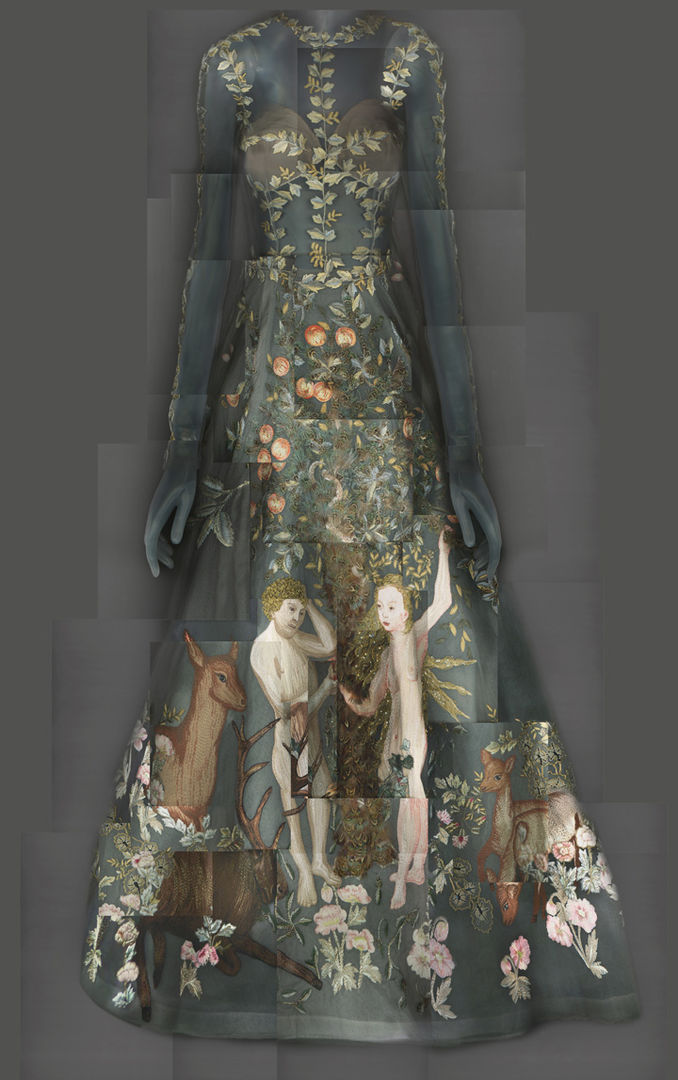
The vastly larger parade of high-fashion outfits spreads across the main floor’s Byzantine, Medieval and Renaissance art galleries. It carries on in the chapels, galleries and gardens at the Cloisters branch of the Met some eight miles north. Upstairs and uptown, razzle-dazzle and glamour with forays into exhibitionism prevail. There are frocks and gowns that incorporate imagery of the Roman Catholic religion including crosses by the score, as well as densely sequinned frocks by Versace and Dolce & Gabbana which portray the Virgin Mary and infant Jesus. There are riffs on the clothes of parish priests, cardinals and bishops; high-fashion angels look down on the crowds of visitors from the top of arched doorways.

Clothes for men make an appearance too. At the Cloisters, for example, a mannequin becomes a designer monk when robed in a hooded brown wool ensemble by Rick Owens, an American fashion designer. It incorporates a protruding open tube (of the same fabric) at crotch level. Lest the viewer’s thoughts dart to the Church’s paedophilia scandals, the caption directs attention to the bawdy characters in Chaucer’s “Canterbury Tales”—written in the safely distant 14th century.

A particularly disconcerting display, also at the Cloisters, goes one metaphor too far. A mannequin outfitted in a lavish white-silk couture bridal gown stands alone before a chapel altar. “Ave Maria” plays on a loop. There is no groom visible; it would be a a fashion show’s culminating coup de theâtre; here it is a fashion exhibition’s coup de grâce. This pretty image, instead of uniting the meanings of divine, mixes up two often life-changing sacred rites and appears to diminish both. Poverty and chastity are among the vows taken by nuns, decidedly not those sworn by couture-clad brides in church marriage ceremonies.

In one of the catalogue essays that provide the intellectual underpinning for this exhibition, David Morgan, a professor of religious studies at Duke University, writes that the “robes, mantles and tunics in which saints appear...make the body the material manifestation of spiritual virtue.” While there is plenty of Catholic iconography in the clothes on view at the Met, the spiritual is absent, almost but not quite entirely: A Jean-PaulGaultier evening dress has a red beaded heart on the left breast, pierced with a sword. From this a rivulet of red silk falls to the floor. Unlike so many other pieces with crosses and such looking merely ornamental, it is exceedingly moving—a work of art. So too is the opulent, pale silk gown by Balenciaga constructed with only a single seam. Both have something divine about them in both senses of the word—as indeed does that bling tiara worn by Pius IX.

Alas, for the aims of Mr Bolton, these are rare exceptions. Overall, the attempt to merge the two meanings of divine flops—sometimes painfully. For those who simply want to enjoy a fabulous theatrical display, the show is downright infallible.
Valentino evening dress featuring a design inspired by Adam and Eve in the Garden of Eden


Sunday, 25 February 2018

Big Man; Big Heart Gunter Blobel

Big Mind; Big Heart    Gunter Blobel  May 21, 1936—February 18, 2018


A brilliant scientist who won the  Nobel Prize for Physiology in 1999, he gave the million dollar award to the restoration of Dresden. He was not born in the city;  it was never his home yet from the age of eight he lived there in his heart.

 
I first met Gunter Blobel in October, 2003. Everything about him seemed over-sized. He was exuberant, expansive. He was also tall, his white hair thick and wavy.  There was something lyrical about the way he talked; his hands swooped around as if in accompaniment to his song.  He managed to look elegant with it being overly casual or studied. On this day he was wearing a white linen shirt, black trousers and a black cardigan. A beige, heavy knit cashmere scarf was wrapped around his neck. He seemed fit but was no body braggart. (Later, I learned from another early bird around the Central Park Reservoir,  that he was an early morning runner.)
Dr Blobel sat down behind a desk was stacked with papers. I was warned me that he was very busy; that our meeting would have be short.  I did not doubt it. I felt sure his daily commitments exceeded the number of hours in a day.  One reason for this may be that he is a charismatic and prodigious talker. It was two hours later that I stood up to say goodbye. I apologized for having kept him from his work.
“When the subject is Dresden,” he said, “I can go on talking for ever.” 
   
  Dresden was the reason I was there.  I was dug into trying to find out more about a famous collection of 18th century porcelain that had been born and two centuries later had met its death in Dresden. It was commissioned by Augustus the Strong, the Elector of Saxony, who made the city his capital. In his race to be the first in Europe with the recipe for hard paste porcelain he had set up a factory at nearby Meissen. The early Meissen collection I was learning about was later sold but it had stayed in Dresden until it was hidden in the mountains outside for safekeeping during the Second World War. Against orders, a truck loaded with it,  was parked overnight in the courtyard of the city’s residence palace. That was the first night of the firebombing. Image result


Surprisingly (some might say miraculously) a decade later a few porcelain survivors of the great collection were dug out of the still unsifted mounds of rubble.  These patched together small figures had become my guides to the collection; to its owners and to the city with which its fate had been intertwined from the first.  Martin Roth, Director of Saxony’s State Museums in Dresden, told me that I must talk with Gunter Blobel. No doubt it was his introduction that made the encounter possible. For all his warmth and generosity of spirit, I suspected that Gunter Blobel would not have patience for people with whom he shared no interests.
   Minutes after we met, we were in the small village in Silesia where he grew up. It was towards the end of the Second World War.  This region, then in Nazi Germany was later in Communist East Germany and now is in Poland. Gunter was one of eight children. The youngest was two; the eldest a teenager and he was eight when his father, a veterinarian, decided that they must leave home where life was “a rural idyll.” The Russians were advancing from the East.
   “People believed the Russian and American armies would meet at the Elbe,” Gunter Blobel told me.  And they were terrified. Russian troops were infamous for rape and robbery.  The family was going to head for the American side of the river and the farm of relatives in western Saxony. The car was packed; off they went.
   Dresden straddles the Elbe.  It was the young boy’s first sight of a big city.  This one packed a particularly potent punch. Since the 18th century, Dresden had been one of Europe’s culture centers: Bach played the inaugural concert on the organ in the Frauenkirche; Wagner conducted the premiere of his Flying Dutchman at the Semperoper.  The Old Masters, porcelain, arms and armour museums were world famous. For centuries, writers had remarked on the beauty of its Renaissance and baroque architecture.  Image result for dresden bellotto

“It was a child’s fantasy,” Gunter Blobel recalled, still  bewitched. “Everywhere there were putti, statues, cupids with arrows pointing down at me. I asked my parents couldn’t we stay longer? They said no.”  The family reached their new if temporary home in early February, 1945.  Within days they heard reports on the radio that Dresden was being bombed.  They already knew. “You could see for a hundred miles, the wine-red sky.”
 The war in Europe was over by May. The family headed east again. “There was rubble instead of road,” he said. “We ate what we could scavenge in the fields.”  Sometimes they found apples; sometimes things that they had to boil before they were edible. “Everywhere there were burnt out farms, dead animals—cows, horses.” Whole villages were destroyed.
  Once again they came to the Elbe.   
   “It took us a whole day to cross Dresden,” he remembered. “It smelled of corpses. Broken statues were on the ground.  It was horrendous, horrendous.”
  This ebullient man I had been listening to had tears in his eyes.  He had not buried his “horrible horrible, unimaginably horrible” memories. He allowed them to lay him low and surely this was not the first time. Yet he had new and marvellous images of the city to soothe him; not least of all because of his own heroic efforts.
   The eight year old who saw Dresden in ruins made a promise: If ever in his life he had money, he would  use it to help rebuild what had been a magical city. In 1991 Dr. Gunter Blobel founded the Friends of Dresden.  In 1999, most of his million dollar Nobel award went for the rebuilding of the city’s glorious Frauenkirche and the replacement of a synagogue to replace one that had been destroyed by the Nazis.
”I cannot tell you how hard I worked to raise the money,” he said.  “I couldn’t do it again.” Because of his passion and all that very hard work, that was not and will not be necessary.


Image result for frauenkirche dresden