Wednesday, 17 May 2017

The Empress's New Clothes: Rei Kawakubo at the Metropolitan Museum of Art


“Art of the In-between,” is a toast to the brilliance, originality and  influence on fashion of Comme des Garcons, the label founded by Rei Kawakubo in 1973 designed by her ever since. Born in Japan in 1942 where she continues to work, Kawakubo’s vaunted importance is spot lit in the press releases issued by the Metropolitan Museum of Art. Make no mistake; this is a big deal. Indeed it is only the second time its Costume Institute has given a fashion designer a one- person show. (The first was Yves Saint Laurent in 1983.)  This time the exhibition is not being displayed in its dedicated and capacious, if largely subterranean, galleries. No indeedee. It is upstairs on the second floor in one of the museum’s special art-exhibition spaces--an elevation in more than the number of steps to climb.


The catalogue is big, chic and gorgeous (of course). It manages to be both flashy and minimalist.  There is a long Q and A “conversation” between Kawakubo and the Institute’s curator/director Andrew Bolton. He asks rihanna the Qs and she, who seldom gives interviews or even speaks where reporters can listen in,  well it would be wrong to call her words a response.  Bolton unfolds before her a plushy red carpet but instead of gliding along it or doing pirouettes, she stalks her own thoughts and expresses them with Intelligence, an independent mind and a certainty that is bracing.   She makes plain they had disagreements, many. He wanted a retrospective; she not. This was a battle she won. The future is her baby or her prey. Try to drag her back to past inventions or even pin her down to the so- called here and now and she turns into a donkey; one that chooses silence over braying. She did not want to be curated; no interpretation, please. That battle she lost.
I never bought or wore anything by Comme des Garcons but I was attracted to what Kawakubo had to say. I was curious, hopeful too, about the show as I headed uptown to see it.

Unlike most museum exhibitions—in fact all that I can recall—the shop isn’t at the end but fills much off the broad corridor out front. I am no shopaphobe but the merchandise could wait. I went straight into the cinematically futuristic, somewhat arctic landscape beyond.
White, amorphously shaped pods –some double- deckers—w-hich looked like they were carved out of non-reflective ice, were like so many avant-garde open-air igloos with mannequins inside. They were arranged in clusters along winding paths. I quickly lost track of where I’d been and where I thought I was going next. This not a criticism. With no time line why not get lost and discover?
I saw many things made of fabric that were fanciful, amusing, bizarre, pretty in parts. The thing is,  with very few exceptions what I did not see was clothes. .

In its early days, Comme des Garcons aficionados in Japan were called Ravens…women who adopted as if a uniform, its loose, long, black, monk/nunish garments; their feet encased by clunky, flat black sardine- can shaped shoes. Image result for comme des garcons ravensThen there were tops with with purpose made holes in them; garments with ragged edges. Seams were not longer necessarily on the inside. Kawakubo took Comme to Paris where for a couple of decades the label shocked; it made news and money. Fashion writers talk about how she liberated women;  no more dressing to seduce men. They are still writing this stuff. It is as dated as she fears those earlier pieces would look.
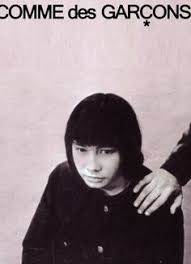
The sleeves on the objects shown at the Met,(if they have any) seldom would allow a person to raise her arm. What, take into account the need for the use of hands? These objects do not liberate the body; they incarcerate it. How has she managed to operate a successful international fashion business selling stuff like this?  Well fashion journalists seem enthralled. But so do shoppers as I found out when I went out front..
  
There is a barrier the size of the Berlin Wall between most of what is in the show and what is for sale. (And it is in no danger of being pulled down. Tee shirts—not unlike French sailor stripped numbers although here in colors besides dark blue--are priced at about $150.00. There are navy cardigans, small zipped pouches in gold leather totally plain but for the stamped words Comme des Garconons. This is Kawakubo’s line called Play and the playful part comes from the logo—a pair of cats eyes joined to form a heart. It appears also on the white Converse trainers selling for $125.


 What with all the hype and all the photographs of Rihanna at the Met Gala to benefit the Costume Institute—decked out in leggy, Comme- couture entry in Rio’s Carnival, the credit card machines were overheating..

This exhibition makes no case for the influence of Rei Kawakubo or of her being a fashion artist.  There is little to compare with the many works of enormous beauty and thrilling invention on view in ManusxMachina—lasat year’s Costume Institute’s big May show. (About which I wrote for the Economist http://www.economist.com/blogs/prospero/2016/06/high-tech-fashion-design). . Gareth Pugh and Iris van Herpen were two of the stars in a sky ablaze with them. “Art of the In-Between” is not a great art show nor is it a fashion exhibition.  On the plus side:    Shop sales should go some way to making up the huge deficit that materialized during the tenure of the Met’s outgoing Director Tom Campbell


.  

Wednesday, 26 April 2017

The Triumph of Death--also Art


Image result for triumph of death palermo
The Triumph of Death; c. 1445  Palazzo Abatellis

A bit of a lead up; context let's say:

In Sicily on this my first trip, I expected to find sweetly sour lemons, bleaching hot sun, undaunted blue skies; Greek temples, Roman and Byzantine mosaics, freshly caught fish and superior arancini that big cone of rice stuffed with ragu. Also expected were miles of mountainous unpopulated countryside. I did find all this but on the hoof the island did not look or feel as it had in my years of longing to see it. The neglected palaces of Palermo I'd imagined would have the poetic beauty of Venice, minus the canals, don't. 
    In April it was often cold. In Palermo it rained in torrents for 48 hours straight. And, like most dreams, mine came without a soundtrack. That was a good thing. 
    There were memorable silent moments for which I remain grateful: My first sight of a Greek temple for example. High above the sea on a breezy bluff in Agrigento's Valley of the Temples I lost my heart (connected to the loss of Greek temple virginity no doubt) to the Temple of Juno.Image result for temple of juno agrigento sicily

  I sat on a big, rectangular block of pale stone which was cut more than 2000 years ago and thought of nothing much, I thought also of walking up from the valley to this temple soon after it was built. The sea was the same sea, after all. The stone, ditto.  And then I all I felt was tense followed by a desire to flee.

  Waves of school groups carrying on not because they were at the site of ancient temples but naturally enough because they were  out of the classroom for the day began shouted as their teachers tried to tell them about the early conquest of the island.. They were quickly joined by tourists travelling in packs led by guides whose spiels could be hard even by the nearly deaf.  At such popular sites, even so-called independent travellers took up a lot of visual space as they worked at getting images of themselves --or in some cases their offspring--that satisfied their vanity.  Remember the spontaneity of kids?  It is now as outdated as the dial telephone and the sound of the bell that rang on manual typewriters at the end of every line.
   "Did you love Sicily?" I am asked. Obviously and as almost always the answer is yes and know. But among the big yeses were such surprises architectural (Noto for example), gastronomical (fish with a sauce of sweated fennel and raisins), topographical (Ragusa Ibla built up the side of gorge like a 17th century Canyon de Chelly) and then the subject for this long preamble--a huge fresco as beautiful as it is terrible--at least for those of us insufficiently philosophical about impending death. 

A great work of art; a masterpiece; an unforgettable creation any and all describe The Triumph of Death (at the top).  It was made (creator unknown) in the middle of the 15th century for the wall of a former palace by then a hospital. It stayed there for centuries. Then, towards the end of WWII it was removed and now hangs in the Regional Art Gallery, Palermo;the Palazzo Abatellis. In the century before this fresco was painted, the Black Plague had killed as many as 200 million people. Death had been everywhere and that include works of art. A century later, this huge work was made (it measures a little over 19 by 24), It is both lyrical and cruel. As one scholar has written; the imagery is too cruel to have been created by an Italian. Guesses include a painter from Aragon or Provence.  

Death dominates; charging ahead on a skeletal horse. Some say the poor folk at the lower left are pleading for mercy; others that they plead to be delivered them from their misery. Either way they are ignored. The rich and otherwise privileged on the right (so unwittingly contemporary in its political positioning), are enjoying their courtly privileges oblivious to what is heading their way. But standing in front of the fresco there is hiding. The rider is coming for you, too.

Displaying 20170426_142123.jpg

On the day of my visit six musicians lined up in a row sat in front of the fresco. They played their stringed instruments nicely.. It was pleasant to hear them. In this case sound was no interference but neither was it a benefit. In silence or wrapped in musical notes death triumphs and the artist of this work unfailing makes his point.. 
If it were in Florence, or Rome, or Milan, "The Triumph of Death," would be on the "must see" list of every travelling art lover. It would have been seen by more art historians and be in every book about the history of Italian art or late Gothic art or just plain great art. Maybe I had once come across a reproduction of it somewhere. I had no such memory.  But in a books or on a screen this work just does not produce the overpowering, exhilarating and chilling impact. To see the Triumph of Death is reason enough to go to Palermo. If you do: Pay better attention that we did to the warning that the city is a haven not only for art lovers but for pick pockets, also.        

Sunday, 26 March 2017

Dream big; execute small


Image result for john endlich dolls house


This year there were 270 international dealers showing and selling at TEFAF  the big and beautiful art and antiques fair that takes place in Maastricht, the Netherlands every year in March.  You could find  Old Master, modern and contemporary paintings and sculpture,, objects of art, jewellery high fashion and antique , silver, drawings, furniture. Most everything is f high quality and expensive to even more so. There are always pieces to covet. But my favorite was a home rather than something I wanted to take to my own. Outside the stand of Dutch dealer John Endlich stood the most charming and surprising object at the fair--a doll's house furnished in the style of a house inhabited by a rich family in the 17th century--the Dutch Golden Age. And it was not only in the style of...The silver furnishings, at least, were original to that period. There was a taste for various kinds of miniatures at the time--mini versions of the Chinese porcelain or Dutch pottery that was in vogue. But the 200 pieces are exceedingly rare survivors representing perhaps two thirds of all that is left..

Imagine that you are collector. You begin slowly but then the bug bites. For 20 years, with the help of your dealer--Mr Endlich in this case--you accumulate a spectacular collection. Eventual you manage to corral some 200 of them--mirrors, garden ornaments, chandeliers, tea kettles, andirons tables, chairs,tables,  musical instruments, chests--oh and a bed- warmer, too. Let's not overlook the wine cooler and garden fountain--the only two of their kind to remain.

You might think such a collection, this collection, would be too adorable or fiddly. What makes it art is the quality of the craftsmanship, the imagination of the makers and a touch of surrealism.  Individually a piece would have been made to scale; a perfectly scaled down version of the original biggie. But the scale used is not uniform. All are miniatures; all doll house ready for that reason, but the table top virginal, for instance, is tiny compared to the dice next to it. The same hand would not have successfully managed both.

It must have been difficult but also fun to hunt down these little treasures. But then came the question of what to do with them? Would the next generation want them? How to guarantee that they would be kept together? If sold one by one, the odds of pieces disappearing would go way up.
.

With the help of his dealer, Mr X found an ingenious solution. A doll house would be made and,furnished with his collection as well such additions as fireplaces and beds of the period., No doubt the three wonderful 17th century doll houses now in the Rijksmuseum in Amsterdam (do not miss if them when you visit) were sources of inspiration. These were never meant as children's playthings.. Indeed  at the time, it cost as much to commission and furnish one of them as it would have been to buy a grand house on one of Amsterdam's canals.
Dolls’ house of Petronella OortmanDolls’ house of Petronella Oortman
Dolls’ house of Petronella Oortman
Problem solved. Set in their new magnificent home, the silver miniatures along with the house they furnished would be sold together. It would all be kept together..

And so it happened at TEFAF this year that in front of Herr Endlich's stand stood a proper Dutch 17th century cabinet on a stand in which nine rooms had been fashioned==from laundry to garden with a view of the neighborhood as it would have been in Holland during the 1600s. The price tag was 175,000 euros.


This story ends fittingly. This dream house is going on a journey across the ocean. It was quickly bought by a collector who is giving it on long term loan to the Boston's Museum of Fine Arts..

Tuesday, 31 January 2017

It takes all kinds of fishes: Michael Andrews at Gagosian


Resurfacing           Michael Andrews (1928—1995


Image result for michael andrews at gagosian images
School 1, 1977 152.5x213

In 1980 Mike Andrews was given a retrospective at the Hayward Gallery. According to the catalogue entry for the work above, the painter, then in his early fifties, had become interested in what people and fish have in common or anyway what the behaviour of the later might tell him/us about ourselves. It is a big, very attractive with wow power on a wall. But decorative is what it is which is to say it is not a work of art. It delights and disappears. Yet Andrews’ created some powerful, enduring works. And some of them, at least, are part of the big show now getting rave reviews at Gagosian’s Grosvenor Hill Gallery


From schools of fish to the School of London, (Alas, I just can’t avoid this one.)  Fishes have nothing to say on the subject. As for the latter, among artists, none agree to belong to it now or ever before. It stuck because it was a  useful for marketing to promote a number of young to youngish figurative painters working in London in the midtwentieth century. Figurative art was not what was happening then and from Abstract Expressionism to Pop, London was not where art was happening; that location was New York.  But living artists working in London at the time and Andrews was among them. His 1962 painting, “The Colony Room 1,” below, includes John Deakin and Bruce Bernard (now famous photographers of that scene) as well as Francis Bacon and Lucian Freud. Thee works have become ever more sought after by collectors and museums with price tags that reflect it.


Following along behind are Frank Auerbach and LeonKossoff.  But Andrews who was successful enough early on to be able to stop teaching, support his family and paint later drifted out of sight. Then around 2007 (it would be interesting to know why) his auction prices suddenly shot up.  Now Gagosian (who is not the dealer representing his estate) is mounting “Earth Air Water,” this ambitious show (closing 25 March).  All 62 paintings are loans—either from private collections or from institutions.  Maybe a few lenders will part with their works for the right price, but overall this exhibition appears to be an image/reputation building event and-- who would object--if it is also a labour of love..

There are pictures to love but for me the show has one major drawback: It focuses an the later works of Michael Andrews and it is the earlier ones that are his best. Why? I could say because that is when he painted in oils and his subject was people. And it is a fact that later  "ideas" and blown- on acrylic took dominate. And the earlier ones, as in the Colony Room, have a warmer temperature.  These paintings matter somehow while the later ones... Well clearly the selectors don’t agree.   

One wall of the gallery is hung with photographs of Andrews, his sitters and friends. The rest of the vast, two storey space is hunt with paintings in oil, acrylic and watercolour-- some of them big enough to fill the wall of a generously proportioned house—but there is nothing homey about this Mayfair space. It is sleek and warehouse huge with high ceilings and window- walls of floor to ceiling glass.  The finishes are as luxurious as its scale. Chic and cool pretty much covers it.  And so is too much of the work  Andrews produced in the second half of his career. 


When I looked at his “Liner” of 1971-1972, a night view of a cruise ship (alas not available for reproduction) my mind’s eye almost immediately replaced it with more poetic and powerful images of a liner at night in Fellini’s “Amarcord” which opened about the same time this work was painted. (An image from the film below.)  I saw the movie years ago and yet it is Fellini’s ship that remains vivid and strong while Andrews’ Liner which was hanging right in front of me vanished as I stood there. And that I think is the heart of the matter.


The series of big bold red and orange Ayres Rock paintings are striking alright. And his fishes are lovely. But blink and they have no more to say; to give; to inspire than a tourist board poster or high class restaurant mural.  They are big, ambitious, attractive yet somehow slight.

The catalogue for this exhibition was written by Richard Calvocoressi, who is Director and Senior Curator of Gagosian London. He knew Mike Andrews and helped organize exhibitions of the artist’s work when he was alive. He talks about Andrews interest in Zen Buddhism. The images of hot air balloons in flight on view in this show are said to represent that efforts to transcend the ego. There is more of these kind of "explaining."  Maybe this helps viewers to see more in the pictures than they would have done otherwise. For me it is hot air not the ego inside those balloons.

I am sorry to say that  once I’ve posted these words, many of these paintings now out of sight will also be out of mind.  Sorry because I like the early pictures so much and because I am interested in many of the books that Andrews read and that influenced him. But I do not want to see the illustrations of the ideas he found so gripping if that is what most of these pictures are. Still "ideas" are all that most gallerists talk about when trying to sell works of contemporary art so it seems very likely that the later works of Mike Andrews will find a large, enthusiastic new audience.. 


Image result for michael andrews at gagosian images