Tuesday, 31 January 2017

It takes all kinds of fishes: Michael Andrews at Gagosian


Resurfacing           Michael Andrews (1928—1995


Image result for michael andrews at gagosian images
School 1, 1977 152.5x213

In 1980 Mike Andrews was given a retrospective at the Hayward Gallery. According to the catalogue entry for the work above, the painter, then in his early fifties, had become interested in what people and fish have in common or anyway what the behaviour of the later might tell him/us about ourselves. It is a big, very attractive with wow power on a wall. But decorative is what it is which is to say it is not a work of art. It delights and disappears. Yet Andrews’ created some powerful, enduring works. And some of them, at least, are part of the big show now getting rave reviews at Gagosian’s Grosvenor Hill Gallery. 


From schools of fish to the School of London, (Alas, I just can’t avoid this one.)  Fishes have nothing to say on the subject. As for the latter, among artists, none agree to belong to it now or ever before. It stuck because it was a  useful for marketing to promote a number of young to youngish figurative painters working in London in the midtwentieth century. Figurative art was not what was happening then and from Abstract Expressionism to Pop, London was not where art was happening; that location was New York.  But living artists working in London at the time and Andrews was among them. His 1962 painting, “The Colony Room 1,” below, includes John Deakin and Bruce Bernard (now famous photographers of that scene) as well as Francis Bacon and Lucian Freud. Thee works have become ever more sought after by collectors and museums with price tags that reflect it.


Following along behind are Frank Auerbach and LeonKossoff.  But Andrews who was successful enough early on to be able to stop teaching, support his family and paint later drifted out of sight. Then around 2007 (it would be interesting to know why) his auction prices suddenly shot up.  Now Gagosian (who is not the dealer representing his estate) is mounting “Earth Air Water,” this ambitious show (closing 25 March).  All 62 paintings are loans—either from private collections or from institutions.  Maybe a few lenders will part with their works for the right price, but overall this exhibition appears to be an image/reputation building event and-- who would object--if it is also a labour of love..

There are pictures to love but for me the show has one major drawback: It focuses an the later works of Michael Andrews and it is the earlier ones that are his best. Why? I could say because that is when he painted in oils and his subject was people. And it is a fact that later  "ideas" and blown- on acrylic took dominate. And the earlier ones, as in the Colony Room, have a warmer temperature.  These paintings matter somehow while the later ones... Well clearly the selectors don’t agree.   

One wall of the gallery is hung with photographs of Andrews, his sitters and friends. The rest of the vast, two storey space is hunt with paintings in oil, acrylic and watercolour-- some of them big enough to fill the wall of a generously proportioned house—but there is nothing homey about this Mayfair space. It is sleek and warehouse huge with high ceilings and window- walls of floor to ceiling glass.  The finishes are as luxurious as its scale. Chic and cool pretty much covers it.  And so is too much of the work  Andrews produced in the second half of his career. 


When I looked at his “Liner” of 1971-1972, a night view of a cruise ship (alas not available for reproduction) my mind’s eye almost immediately replaced it with more poetic and powerful images of a liner at night in Fellini’s “Amarcord” which opened about the same time this work was painted. (An image from the film below.)  I saw the movie years ago and yet it is Fellini’s ship that remains vivid and strong while Andrews’ Liner which was hanging right in front of me vanished as I stood there. And that I think is the heart of the matter.


The series of big bold red and orange Ayres Rock paintings are striking alright. And his fishes are lovely. But blink and they have no more to say; to give; to inspire than a tourist board poster or high class restaurant mural.  They are big, ambitious, attractive yet somehow slight.

The catalogue for this exhibition was written by Richard Calvocoressi, who is Director and Senior Curator of Gagosian London. He knew Mike Andrews and helped organize exhibitions of the artist’s work when he was alive. He talks about Andrews interest in Zen Buddhism. The images of hot air balloons in flight on view in this show are said to represent that efforts to transcend the ego. There is more of these kind of "explaining."  Maybe this helps viewers to see more in the pictures than they would have done otherwise. For me it is hot air not the ego inside those balloons.

I am sorry to say that  once I’ve posted these words, many of these paintings now out of sight will also be out of mind.  Sorry because I like the early pictures so much and because I am interested in many of the books that Andrews read and that influenced him. But I do not want to see the illustrations of the ideas he found so gripping if that is what most of these pictures are. Still "ideas" are all that most gallerists talk about when trying to sell works of contemporary art so it seems very likely that the later works of Mike Andrews will find a large, enthusiastic new audience.. 


Image result for michael andrews at gagosian images


Sunday, 15 January 2017

Life; one box at a time


From my archive
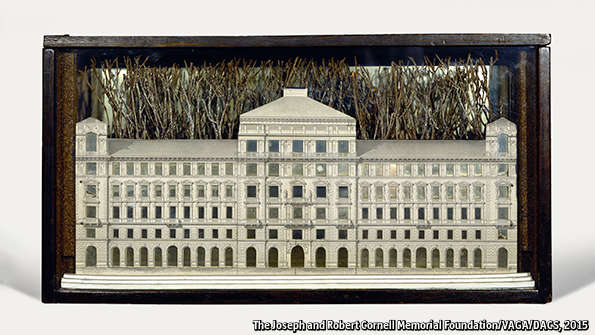
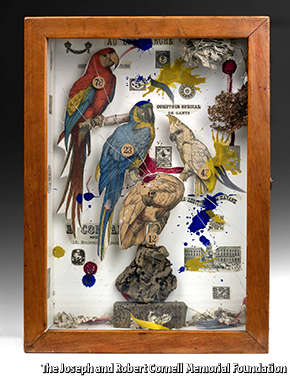
MANY artists are unconventional, but Joseph Cornell (1903-1973) was more so than most. His chosen medium, for example, was not paint or stone but stuff: twine, marbles, plastic toys, playing cards, maps (celestial and terrestrial), photographs, etchings, clay pipes, advertisements, stamps, sea shells, music, small glass bottles, coiled springs, newspaper clippings, film and children’s games. He organised these into folders labelled “Durer” or “Dried Pigments” or “Watch Parts”. Unlike contemporaries such as Pablo Picasso and Georges Braque who sometimes employed such things in their work, Cornell used nothing else. Boxes were his thing.
Until their deaths in the 1960s, Cornell lived his entire adult life with his mother and younger, wheelchair-bound brother. His studio was in the basement of the family home in Queens, New York, a city he seldom left. From his vast stash of stuff he created fantastical, boxed collages of two- and three-dimensional objects, as well as assemblages housed in small vitrines. These pieces, in which childhood fancies were given a Surrealist edge, made him famous in America. Yet more than 40 years after his death he remains little known elsewhere. His singularity was his strength, but it also held him back. However much artists balk at being lumped together into movements, schools and “isms”, such packages help promote them internationally. 
“Wanderlust”, at the Royal Academy in London, is Cornell's first British solo show. It has 80 pieces, arranged into themes like “Play and Experiment” and “Collecting and Classification”. These are arbitrary—just about anything Cornell made can be called playful or experimental—but at least they are not intrusive, and his work captivates from beginning to end. “Tilly Losch”, (c.1935) is a box covered in marbled paper, inside which the cut-out figure of a girl in old-fashioned dress drifts far above a snowy mountain range. She is suspended by strings as if hanging from a hot air balloon. In “Object (Soap Bubble Set)” (1941), a clay pipe—its bowl in the grip of a bird’s talons—emits a string of bubbles each of which contains a sea shell.
“Pharmacy”, made two years later, is a wooden case holding a grid of glass shelves on which rest 20 vials of such remedies as wood shavings and butterfly wings. (The artist, a Christian Scientist, believed that faith not drugs cured physical ills.) Clearly Cornell borrowed from René Magritte and Marcel Duchamp as others, including Damien Hirst, would later borrow from him. In time though, Cornell found his own vision and stuck with it. He added film and theatre to his repertoire, but whatever the form he worked in collage and assemblage exclusively. 
The scale is always small, which gives these pieces a feeling of intimacy. It is as if the viewer is entering a place where the everyday and the fabulous are locked in an embrace. It is a union that is always passionate, if occasionally disturbing: intimate does not necessarily mean cosy, any more than the things of childhood are necessarily all sweet.
Cornell was a magnet for myths. This is not surprising: his art was far better known than he was and it was unlike anyone else’s. Though rumoured to be a recluse, or even a madman, he was sociable in his own way. His friends and champions included Duchamp, Peggy Guggenheim and Mark Rothko. And while he did not personally crave the spotlight, he was ambitious for his art, and successful from relatively early on. He never lacked for influential dealers, first those specialising in Surrealism, later in Abstract Expressionism. There is no denying that Cornell was an obsessive. But to judge by the evidence on view at the Royal Academy, he was also a splendidly functional artist.

Great show but not a great showing by the Met


JAR at the METROPOLITAN MUSEUM OF ART
from my archive; originally printed in The Economist

IN 1978 Joel Rosenthal, then a fledgling designer with a passion for gems, opened a small shop off Place Vendôme in Paris. He and Pierre Jeannet, his partner, named it JAR after the designer’s initials (his middle name is Arthur). Mr Rosenthal, who was born 70 years ago in the Bronx, says, “I wanted to fall flat on my own face or make my own name.”
He certainly succeeded in the latter. Mr Rosenthal is insistent that he had no powerful backer, either social or financial. Passers-by were not encouraged to drop in. The only publicity was word of mouth. Yet the famous and the rich soon found their way to his door, lured by the uniqueness of his creations.


The jeweller combs the world for quality gems, constantly expanding his range with unusual, even unfashionable stones, including green garnets, pink sapphires and black diamonds. His pieces are often unusually large and deeply three-dimensional. A brooch of two life-size, gem- laden lilacs is instantly recognisable as being by JAR. These are jewels for the chauffeured, not for those who need coats.
Mr Rosenthal has written that “beauty, art and luxury are inseparable from happiness.” His prices are not listed, though there are clues. In May 2012 Lily Safra, a philanthropist, auctioned 18 of her JAR pieces at Christie’s in Geneva in aid of charity. They fetched nearly $11.5m. Among them was a 37.2-carat diamond she had brought to Mr Rosenthal. “I can camouflage that,” said the charmer, who can also be blunt. He wrapped it in the twisting stem of two poppies made of pink and green tourmaline (pictured).
Eleven years after his only public show so far, at London’s Somerset House, Mr Rosenthal is about to become better known. Some 400 pieces are on view in “Jewels by JAR” at the Metropolitan Museum of Art. Many were made over the past decade and all are loans. This is the jeweller’s first American retrospective and the museum’s first display of “a contemporary artist in gems”. Tom Campbell, the director, believes people will see how the Met’s jewellery collection, which spans 2,000 years, has influenced Mr Rosenthal. In turn, JAR’s jewels will enable them to see the Met’s collection “with fresh eyes”.
These adornments and objets d’art, ranging from an amusing engraved bagel made of wood to a translucent amber pocket watch, occupy a single, spacious oval gallery. The walls are dark salmon in colour. The light is dim except inside the velvet-lined vitrines, which line the gallery’s perimeter and also stand freely within the central space. The effect is dramatic.
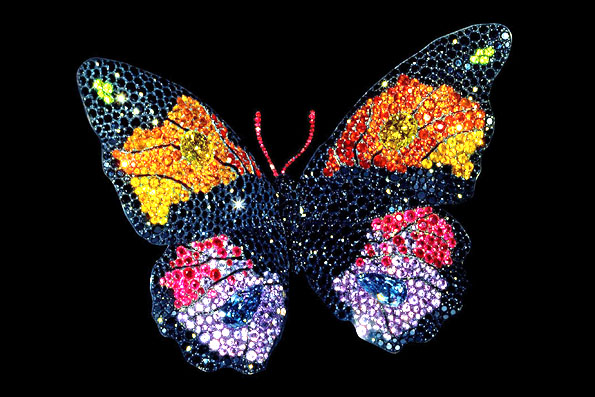
The pieces are loosely arranged by category: flowers, animals, sea life. There are plump ruby roses and camellias from a fairy-tale garden. In one small vitrine a flat-faced hellebore covered in diamonds and violet sapphires rests alongside its case—a round snowball made from a smoky rock-crystal studded with diamond snowflakes; apt for a flower that is also called the Christmas rose. In JAR-land even the ferns are pavéd in diamonds. Among the beasts, a soulful zebra-head brooch carved from agate wears a diamond halter and plumed headdress. The exhibition ends with a wall of butterfly brooches, each one larger-than-life-sized and closely set with intensely coloured gems—including fire opals, amethysts and garnets.
Mr Rosenthal wants visitors to look at his creations without being distracted by long explanatory captions or audio guides. This is effective; all attention is on the jewels. But the Met is not a shop where such a presentation would suffice. There ought to be a catalogue, for instance, with information about the rarity and source of the gems, comparisons with JAR’s most inventive contemporaries and comments from clients about commissions. Instead, the museum shop is offering only luscious picture albums (a short one with a biographical essay priced at $40 and a giant edition, which costs $800).
The museum deserves praise for exhibiting the work of an exceptional living jeweller, but not for letting him call the shots (even basic information, such as the size of the pieces, is missing). This is a sensational advertisement for JAR, as well as a fantastical, occasionally funny show, which is often very beautiful. For the visitor, that is both terrific—and not enough.

No price too high for fantasies


Purported to be a ring belonging to Joan of Arc
(From my archive; as originally published in the Economist.)

A MODEST, 15th-century silver ring for which an ambitious London dealer might ask £1,000 sold for an astonishing £297,000 at TimeLine Auctions on February 25th, a world auction record for a medieval European ring. There could not be a better example of the degree to which a stellar provenance affects the market value of an object: It was suggested, with the aid of documents sold with the ring, that the original owner of Lot 1220 was Joan of Arc, who led the French army against English invaders, a martyr and patron saint of France.
The high bidder was Puy du Fou, a history theme-park in central France created by Phillipe de Villiers. French media erupted in exclamation marks. Honour is saved! The ring is coming home! Hearts may swell and eyes tear; facts, however, remain. Or, perhaps, it is more accurate to say, an insufficiency of facts. There is a scarcity of the sort of archival evidence—wills, inventories, letters, diary entries—that scholars need to produce a solid provenance. And yet the conviction that Lot 1220 was Joan’s has taken hold. It is a tale in which politics, mistaken identity, passion, hope and mystery all play a part.
Joan was tried for heresy, found guilty and burned at the stake in 1431. During the interrogation which preceded this, in response to questions from Bishop Cauchon, the Maid of Orleans said that she had had two rings. The one given to her by her parents was by this time in the possession of the Burgundians, England's allies, who had caught her. On it were the names of Jesus and Mary and also, she thought, there were three crosses. The other ring, given to her by her brother, is not described. That wasn’t necessary, after all, since it was in the possession of her interrogators. After her death, that ring passed from Bishop Cauchon to the English Cardinal Henry Beaufort, who had been present at her execution. During the 500 years that followed there are no contemporary records of Joan of Arc’s rings. 
This changed in the early 20th century—a time when interest in Joan and her achievements, rekindled in the 19th century, was high; she was beatified in 1909. Lady Ottoline Morrell, a British aristocrat and a frequent hostess of the Bloomsbury group of writers, had a silver medieval ring she thought might have belonged to Joan. In time she gave it to Augustus John, a painter, who sold it in 1914. The first published association of the ring with Joan was three years later. Its then owner, F.A.H. Oates, included an illustration of it in the privately printed catalogue of his collection. It is the same ring as Lot 1220. Thirty years later, James Hasson, who owned it, commissioned a genealogy that traced Lady Ottoline’s ancestry back to Cardinal Beaufort. The name of the person in each generation who would have owned the ring was highlighted. Dr Hasson was reassured by this of the ring’s authenticity. The museums in France to which he loaned it seemed to agree. It was displayed as having been Joan of Arc’s. And yet a family tree by itself is not a widely accepted provenance. It might have been; it could have been; this does not mean it was. The new owner of Lot 1220 evidently was not deterred by this.
Nicolas de Villiers, son of Puy du Fou's founder and president of the theme-park today, concedes that the attribution is hard to believe. However, he was convinced that the ring is Joan's after a telephone conversation with Jacques Trémolet de Villers, a lawyer, monarchist and author whose works include an account of Joan of Arc's trial. During the call, which took place only days before the sale, Mr Trémolet pressed him to buy the ring which he said matched Joan's "precise" description of it—the three crosses and all. After hearing this, and acting on "instinct", Nicolas de Villiers decided to go for it. A 36–hour canvas of his rich friends produced the war chest for his successful bid. On March 20th, Joan of Arc's ring, the prize, will be unveiled to the public at the park. Or will it? 
There is no reason to believe that the ring with Jesus and Mary and the crosses that Joan described to Bishop Cauchon is the one he handed over to Cardinal Beaufort. There is no description to identify it. Well then, did the ring already possessed by the Burgundians, about which nothing more was recorded, suddenly reappear in the 20th century—effectively out of nowhere—and land in the jewellery box of Ottoline Morrell? No one can prove that it did not, of course. But neither has anyone proven that it did. What can be said is that some believe that it matches Joan’s description of her ring, closely, and that it is unique. Others, however, including the specialists consulted by this reporter, do not agree.
"I have yet to talk to a museum curator, an art dealer or an independent scholar who believes that the association with Jeanne d'Arc dates back to her lifetime," says Sandra Hindman, a medievalist, professor emerita at Northwestern University and dealer in medieval art and rings. "I personally believe that the attribution of the auctioned ring was part of the Jeanne d'Arc mania that begins in the 19th century and continues until about the mid-20th century." Her opinion was echoed by the other experts consulted by this reporter.
The attention given to the sale of Lot 1220 has brought international publicity to the auction house, which has posted a new video about it; its cataloguing of the ring as associated with the one given to Joan by her parents and later owned by Cardinal Beaufort remains unchanged. The theme-park has been widely publicised too. The vendor got far more for Lot 1220 than he expected. France bubbles with national pride, and may become even more joyful on hearing that the vanquished, next-highest bidder was Berganza, an English dealer. Politically, too, the ring is providing a boost: Joan of Arc is a particularly potent symbol for right-wing parties.
Indeed, some centrist and left-leaning Frenchmen feel that the Maid of Orleans, heroine of their schooldays, has been hijacked by the right. Every year on May 1st, the xenophobic and populist National Front gathers at her statue in Paris. Marine le Pen, its leader, tweeted "Thank you to @PhdeVilliers for bringing Joan of Arc's ring back to French soil." Was this a generous move, or a pre-emptive one? Philippe de Villiers is a leader of the Movement for France, a smaller rival to the National Front. Now his family appears to have won Joan of Arc for his followers. There is talk of national fundraising campaign to build a chapel at the theme park to house its precious relic. Whatever their politics, its millions of visitors will be awed. For many, it would seem, this tale has a happy ending—but not for all.