Saturday, 26 March 2016

Wim Pijbes leaves the Rijksmuseum on a low note.


kapoor4


Anish Kapoor's three blood- and- guts, thickly painted reliefs hang in the Rijksmuseum's Hall of Honor until April 3.  According to the museum's blurb "they enter a visual dialogue with Rembrandt's late works such as The Jewish Bride," which hangs in a room opposite.  Who can believe that walls covered with what looks like what's been mopped up after a bomb explosion is having a discussion with the intimate, tender but complicated double- portrait below?  

Rembrandt Harmensz. van Rijn - Portret van een paar als Oud-Testamentische figuren, genaamd 'Het Joodse bruidje' - Google Art Project.jpg

 Anish Kapoor, after an exciting beginning, has become a globally famous artist whose current work disappoints a number of former fans including this one.  Like just about any visual artist he must have been thrilled to be invited to show his work in this spo-- adjacent to those by one of the greatest painters in the history of western art; the artist whose works draws millions to the Rijksmuseum every year. But why in the world was he asked?  To help visitors better appreciate Rembrandt? I fear that as answers go this one isn't as ridiculous as it sounds to me.
    Since the museum re-opened in 2013, Wim Pijbes, the museum's director has been trying to --well what exactly? Make it more relevant? Sexier? More cool? Or has he been trying to make himself feel those things? He came from a museum without a permanent collection and is about to become director of a not- yet- opened Dutch private museum of contemporary art. It is only a guess and possibly a very wild one, but might it be that although the offer of becoming director of  the Rijks appealed to him a lot, the stuff in the place did not, much.

  Pijbes deserves a lot of credit for getting the great museum re-opened after a decade of delays; for then leading the way in encouraging free use of images from the collection without restrictions (except for the minority of works still in copyright). But there has also been too much of what looks an awful lot like dumbing down. First it was the folksy labels and wall texts. Then came the misbegotten Hall of Honor "conversations" between works by a living artist with great paintings by the Netherlands' --some would argue the world's-- greatest artist. The series has reached its nadir with the current pus, blood and vomit reliefs by Kapoor. I have no idea who actually extended the invitation. But surely if it was not the director he could--and should-- have just said no.
 

Wednesday, 24 February 2016

Bosch at home or It's the Netherlands vs Spain all over again (and I don't mean football.)


Image result for hieronymous bosch exhibition images


Five hundred years ago Hieronymus Bosch died in the city of his birth, s'Hertogenbosch in the Netherlands. The son and grandson of painters named Aken, he took his home town's name for his own; an ambitious man he may have thought this would flatter local burghers and churchmen who would be more likely, therefore, to give him commissions. This they surely did. Bosch was enormously successful; his workshop prolific. His triptychs and portraits decorated churches, religious fraternities, grand houses and the palaces of Philip II of Spain who king of the Spanish Netherlands, too. Today only 24 of his paintings and 20 of his drawings survive. (How this figure was arrived at and which works are deemed to be by his hand and which not, leads us to the saga of the current sometimes petulant; sometimes prideful disagreements between art experts in the Netherlands and Spain. Later for that; first to what is most important.) "Visions of Genius," at Het Noordbrabants Museum is a great show. On view are 17 of Bosch's paintings and 19 of drawings as well as works by contemporaries and objects from the period to provide a bit of context.  By the time I left the exhibition my ideas about Bosch, what he showed me through his work, had changed dramatically.
  Since my teens I had seen the artist as a freak; a wild but masterful traveller into nightmare land; a surrealist before surrealism; an interpreter of dreams centuries before Dr Freud.  In Den Bosch my eyes grew up. The artist's vision has not changed of course. It remains singular, extraordinarily imaginative, thrilling and disturbing, But now I grasp that these creatures with fish heads or insect bodies are not the hallucinations of a deranged mind or an inspired dreamer.  Bosch's visions of good and heave; heaven and hell were real to him and he used his great talent and skill to make them real to us. The drawings too, many of them exquisite in their own right, are studies for birds and rodents,bearded men with crab claw limbs.as detailed--as carefully observed--as if they were posing for the artist in his studio..
   The show had other surprises for me, too, including some beautiful portraits of Christian saints. Of these my favourite is his St Christopher (c.1490-1500) above.  I felt the struggle and the grandeur of the giant swathed in lavish red cloak and the serenity and trust of Christ child on his back as he is carried across the river. In the background a hunter, his cross bow to one side, struggles to hoist a newly killed bear from the limb of a tree; To one side a small figure (a hermit?) sits inside a jug that nestles in the branch of a barren tree as if lighting the way for the travellers. The lifelike and the imaginary all equally "real."

St Christopher Bosch A2 Box Canvas Large

The Prado Museum in Madrid holds 6 paintings by Bosch in its permanent collection. Or so it did before, as a result of a decade long Dutch based research project, two were demoted. The project with its own website well worth checking out, has developed dazzling high- tech tools for analysing paintings. This has led to statements of absolute certainty in the Dutch catalogue of the works which may not be accepted elsewhere. The degree to which technological investigations should be depended upon for attribution remains a matter of debate. Certainly the Prado does not seem to share the convictions about attribution made in the Den Bosch show. This may have more than a little to do with the Prado's refusal at the last minute to lend two works and perhaps to the National Gallery in London's choice to lend only to Madrid. What is more, somewhere along the way, the Prado decided to do its own major Bosch exhibition. I follows on from the Dutch show, opening in Madrid on May 31. Both museums claim theirs is the greatest show ever of the artist's work.

So Bosch lovers: Should you travel to the Netherlands or to Spain to see a show that, unusually, more than lives up tot the hype?  To limit the decision only to what else is in the museums, Madrid is the obvious choice with the Prado's collection of works by Titan,Velazquez, Goya and more. Yet I am glad I saw the exhibition in the painter's home town. Its lack of distractions may be a hardship for its tourist board but it was a plus for me.  My focus was and remained on Bosch.  I was able, at least, to taken in how he went to show us the world he lived in; the world we live in today.  With all the media imagery of romances and disasters that envelop us; his vision has unsurpassed power.

Thursday, 28 January 2016

Picasso a sweetie not a sadist--in 3D

Picasso had a sadistic streak and that was not his only less than admirable trait. There is plenty of evidence of this in his painting as well as his biography. But when he set to work in three dimensions the results are never harsh or painful. These works are heart lifting; joyful.  I smiled a lot as I walked around the big show of his sculpture now at the Museum of Modern Art (MoMA) in New York. There are models of monumental outdoor works; portraits including one of his muse mistress Marie-Therese Walter that is now subject to legal wrangling about its rightful owner; there are birds, monkeys, goats and glorified stick figure on a beach that are filled with the pleasures of being alive.

You can't help feeling that he when he put down his paint brush and picked up sheets of metal; plaster and wire or bits of old machinery he left his demons behind, temporarily.   But, I suppose, he also sailed away from tenderness and passion--the qualities that make his Vollard Suite etchings a great maybe the greatest visual love poem.

Faun uncovering a sleeping woman   from the Vollard Suite

This show is fun, an adventure and more evidence that his celebrity is not built on hype. See it before it closes on Sunday February 7.

Wednesday, 6 January 2016

Stitching up India

Wall hanging (detail), cotton appliqué Gujarat 20th century, Victoria and Albert Museum London


This is part of a panel from a room-sized hand-appliqued wall covering. You can see in its middle a flap that, like a curtain or a blind, which lifts up to reveal what is outside. It currently covers the four walls of a room at the Victoria & Albert Museum, part of its large, exciting,colorful, surprising and informative exhibition, "The Fabric of India," --the first such show of its kind.
      Everything was made by hand--whether for temples, festivals, home decoration, courtiers or kings or I should say Sultans and Maharajahs. It is never dull--well except for the saris which while sometimes made of lovely fabric look so boring on the lifeless mannequins. (With the exception of wizards like those responsible for the Alexander McQueen exhibitions, it usually takes warm bodies to make clothes interesting.
     There is politics and its side kick economics too. India did a thriving global trade in fabrics until the mills of Manchester put many of the hand weavers and embroiders of India out of work. Gandhi took up their cause. Spinning and wearing hand- woven cloth became part of his political program. The role of fabrics in India's fight for independence is a small but gripping part of this exhibition. It is welcome, too, that dumb luck has a small role.  .
   The wall hanging shown above was found one evening in 1994 by a fellow strolling down the street in New York. Back in the days before eBay people in New York routinely through stuff out onto the streets when their apartments became too cluttered. Few had access to attics and basement so turfing out was normal. A lot of what was tossed really was trash but quite a bit only seemed like junk to the disposer. We are lucky that this man passed by before the garbage trucks; that now we can see this terrific hanging on display==and a great deal more that was made by hand==spun, woven,embroidered, dyed and painted by men and women in India. The shop has covetable examples of the work they are doing today. Temptation there is, and I fell.


Friday, 2 October 2015

Yippee: London's National Gallery will remain free to all

National Gallery, Trafalgar Square
The annual press conference presenting the National Gallery's upcoming year in exhibitions took place this week. It was also a formal introduction to the NG's new Director, Gabriele Finaldi and to Hannah Rothschild the new (and first female) Chair of its trustees.  They both stressed that in spite of the government's repeated cuts, admission will remain free to all.   This is great news not least of all because there has been plenty of gossip about that other museums--all victims of government cuts-- are considering reintroducing admission charges-- in spite of the clear and strong evidence that the numbers visiting soars when people do not have to pay.
  Starting in November--may it only be earlier--its galleries will no longer be shut because of strike action.  That is when the contract with an external security providing company goes into force. The mismanagement that led to a prolonged strike of the gallery's security employees has been outrageous. Tens of thousands of British and foreign visitors have been unable to see many of the paintings for which the NG is justifiably world famous.  Whatever his achievements, Sir Nicholas Penny did not end his stint as Director on a high note.
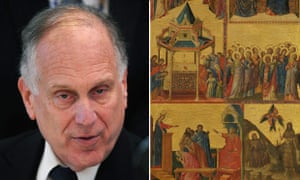
Ronald S Lauder and a section of the Giovanni da Rimini painting Scenes from the Lives of the Virgin and Other Saints.    Next move: Get the UK government to change the tax laws to encourage philanthropy. Take the lead from the United States where museums and museum goers are enormously enriched because of gifts from private sources. Even the NG is benefiting from that: On view during the the press conference was a beauty of a small painting by Giovanni da Rimini. New York art lover and billionaire Ronald Lauder gave the National Gallery the money to buy the 15th century painting at Sotheby's in London last year. During Mr Lauder's lifetime it will be on public view every three years for three months and otherwise wherever he chooses to display it. Everybody wins.

Tuesday, 11 August 2015

London's Museums: Let them eat praise


The politicians and the great and good or equivalent were patting themselves on the back. Under the enormous twisting glass Medusa tendrils of Dale Chihuly's chandelier the crowd at the Victoria&Albert Museum hoovered up tasty canapes and drank nicely chilled white wine. London & Partners "the official promotion company for the capital" bash to encourage the press to get the message out:  London's museums are more Googled than those of any place in the world.  A video message from our blond bombshell mayor Boris Johnson Visitor numbers are way up. Americans are coming in droves. I like a good party but my response to this one was outrage.                                     .
  .The budgets for London's museums are being cut way back ==again. Much of the National Gallery is closed to visitors because its security staff has been on strike for months. Tough luck for all those millions who want to see Leonardo or Veronese.  One or another of the British Museum's galleries are often shut because of staff shortages. The V&A, whose deputy director spoke at the party and which is launching an expansion into East London, has cut curatorial staff so severely that some departments feel they are bleeding to death.
    Hey but why spoil the party? Well because the situation is terrible. Either the government must support the art institutions that are the pride of the country and bring millions of visitors and pounds sterling to the capital every year or it must alter the tax structure to encourage private individuals and corporations to take over their running costs. It is that simple.


Wednesday, 5 August 2015

Making a Splash: Sickert in Dieppe


Under valued, under appreciated but coming up fast, at last.
Walter Sickert, L’Hôtel Royal, Dieppe, 1894, oil on canvas, 50.2 x 61 cm, Museums Sheffield|


Image result for walter sickert DuquennesThe photograph of a handsome man in his sixties, hair slicked back, hands on hips, wearing a thigh length, horizontally stripped bathing costume faces the title page "Sickert in Dieppe," a rewarding exhibition at the Pallant House Gallery in Cirencester.  He looks straight into the camera while knee high in the foaming waves of the English Channel off the Normandy coast. The year was 1920. In fact he might have been staring inland at the Royal Hotel on the front yet nothing about him connects him with the painting of that hotel he completed in 1894, more than a quarter of a century before. It is charming, delightful even and safe. Yet only 8 years later, still in Dieppe he painted "The Fair at Night" seen on the right. And "Le Grand Duquesnne, Dieppe" (left) one of four powerful paintings commissioned for a restaurant which the timid owner rejected. This rewarding, revelatory show gives plenty of support to those who argue that if Sickert remained in Dieppe instead of returning to England he would be far more famous than he is today. He is a much better painter than some French contemporaries who are better known (Sisley comes swiftly to mind), more highly praised and whose work sells for more money.