Wednesday, 6 January 2016

Stitching up India

Wall hanging (detail), cotton appliqué Gujarat 20th century, Victoria and Albert Museum London


This is part of a panel from a room-sized hand-appliqued wall covering. You can see in its middle a flap that, like a curtain or a blind, which lifts up to reveal what is outside. It currently covers the four walls of a room at the Victoria & Albert Museum, part of its large, exciting,colorful, surprising and informative exhibition, "The Fabric of India," --the first such show of its kind.
      Everything was made by hand--whether for temples, festivals, home decoration, courtiers or kings or I should say Sultans and Maharajahs. It is never dull--well except for the saris which while sometimes made of lovely fabric look so boring on the lifeless mannequins. (With the exception of wizards like those responsible for the Alexander McQueen exhibitions, it usually takes warm bodies to make clothes interesting.
     There is politics and its side kick economics too. India did a thriving global trade in fabrics until the mills of Manchester put many of the hand weavers and embroiders of India out of work. Gandhi took up their cause. Spinning and wearing hand- woven cloth became part of his political program. The role of fabrics in India's fight for independence is a small but gripping part of this exhibition. It is welcome, too, that dumb luck has a small role.  .
   The wall hanging shown above was found one evening in 1994 by a fellow strolling down the street in New York. Back in the days before eBay people in New York routinely through stuff out onto the streets when their apartments became too cluttered. Few had access to attics and basement so turfing out was normal. A lot of what was tossed really was trash but quite a bit only seemed like junk to the disposer. We are lucky that this man passed by before the garbage trucks; that now we can see this terrific hanging on display==and a great deal more that was made by hand==spun, woven,embroidered, dyed and painted by men and women in India. The shop has covetable examples of the work they are doing today. Temptation there is, and I fell.




Friday, 2 October 2015

Yippee: London's National Gallery will remain free to all

National Gallery, Trafalgar Square
The annual press conference presenting the National Gallery's upcoming year in exhibitions took place this week. It was also a formal introduction to the NG's new Director, Gabriele Finaldi and to Hannah Rothschild the new (and first female) Chair of its trustees.  They both stressed that in spite of the government's repeated cuts, admission will remain free to all.   This is great news not least of all because there has been plenty of gossip about that other museums--all victims of government cuts-- are considering reintroducing admission charges-- in spite of the clear and strong evidence that the numbers visiting soars when people do not have to pay.
  Starting in November--may it only be earlier--its galleries will no longer be shut because of strike action.  That is when the contract with an external security providing company goes into force. The mismanagement that led to a prolonged strike of the gallery's security employees has been outrageous. Tens of thousands of British and foreign visitors have been unable to see many of the paintings for which the NG is justifiably world famous.  Whatever his achievements, Sir Nicholas Penny did not end his stint as Director on a high note.
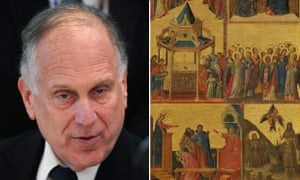
Ronald S Lauder and a section of the Giovanni da Rimini painting Scenes from the Lives of the Virgin and Other Saints.    Next move: Get the UK government to change the tax laws to encourage philanthropy. Take the lead from the United States where museums and museum goers are enormously enriched because of gifts from private sources. Even the NG is benefiting from that: On view during the the press conference was a beauty of a small painting by Giovanni da Rimini. New York art lover and billionaire Ronald Lauder gave the National Gallery the money to buy the 15th century painting at Sotheby's in London last year. During Mr Lauder's lifetime it will be on public view every three years for three months and otherwise wherever he chooses to display it. Everybody wins.

Tuesday, 11 August 2015

London's Museums: Let them eat praise


The politicians and the great and good or equivalent were patting themselves on the back. Under the enormous twisting glass Medusa tendrils of Dale Chihuly's chandelier the crowd at the Victoria&Albert Museum hoovered up tasty canapes and drank nicely chilled white wine. London & Partners "the official promotion company for the capital" bash to encourage the press to get the message out:  London's museums are more Googled than those of any place in the world.  A video message from our blond bombshell mayor Boris Johnson Visitor numbers are way up. Americans are coming in droves. I like a good party but my response to this one was outrage.                                     .
  .The budgets for London's museums are being cut way back ==again. Much of the National Gallery is closed to visitors because its security staff has been on strike for months. Tough luck for all those millions who want to see Leonardo or Veronese.  One or another of the British Museum's galleries are often shut because of staff shortages. The V&A, whose deputy director spoke at the party and which is launching an expansion into East London, has cut curatorial staff so severely that some departments feel they are bleeding to death.
    Hey but why spoil the party? Well because the situation is terrible. Either the government must support the art institutions that are the pride of the country and bring millions of visitors and pounds sterling to the capital every year or it must alter the tax structure to encourage private individuals and corporations to take over their running costs. It is that simple.


Wednesday, 5 August 2015

Making a Splash: Sickert in Dieppe


Under valued, under appreciated but coming up fast, at last.
Walter Sickert, L’Hôtel Royal, Dieppe, 1894, oil on canvas, 50.2 x 61 cm, Museums Sheffield|


Image result for walter sickert DuquennesThe photograph of a handsome man in his sixties, hair slicked back, hands on hips, wearing a thigh length, horizontally stripped bathing costume faces the title page "Sickert in Dieppe," a rewarding exhibition at the Pallant House Gallery in Cirencester.  He looks straight into the camera while knee high in the foaming waves of the English Channel off the Normandy coast. The year was 1920. In fact he might have been staring inland at the Royal Hotel on the front yet nothing about him connects him with the painting of that hotel he completed in 1894, more than a quarter of a century before. It is charming, delightful even and safe. Yet only 8 years later, still in Dieppe he painted "The Fair at Night" seen on the right. And "Le Grand Duquesnne, Dieppe" (left) one of four powerful paintings commissioned for a restaurant which the timid owner rejected. This rewarding, revelatory show gives plenty of support to those who argue that if Sickert remained in Dieppe instead of returning to England he would be far more famous than he is today. He is a much better painter than some French contemporaries who are better known (Sisley comes swiftly to mind), more highly praised and whose work sells for more money.


Sunday, 21 June 2015

Rubies, the fourth "r"


Image result for van cleef rubiesA long time ago, it was reading, writing and rithmatic. Now I've added rubies with a minor in emeralds and sapphires or I have tried to. This time my studies took place at l'Ecole off the rue de la Paix in Paris which looks absolutely nothing like P.S. 79 on Morris Avenue where I used to win spelling bees.

Van Cleef & Arpels, a global star in high jewellery, created this school. It occupies a handsome building around the corner from its flagship store near Place Vendome. When I was invited to take one of its courses I was pleased to be asked but not keen to accept. With subject titles like "Stories and Inspirations," or one session offering advice from a stylist  I reckoned the courses were intended to be a luxe and chatty interval between lunch and cocktails. But then people I know who had been said I should give it a chance. I did.

The course I elected was:  "Gemstone Identification: Recognize the Stones."  I doubt that I'd be crazy about rocks even if I could afford them. But looking at beautiful stones even small ones when set in jewels is appealing and it would be good to know if what I am ogling is the real thing or glass.  I know that rubies are red, emeralds green and sapphires blue and even that this is not necessarily so. But how to tell a ruby from a spinel? Or a ruby that was made by a devious man not amoral Mother Earth?  So off I went to Paris to my class, student numbers limited to 16.
Image result for Van cleef sapphires
Orientation was civilized. Coffee, tea, varieties of water and juices plus thinly veiled social awkwardness. Then it was into class.The large, light classroom looked like a lab with one long table edged with high stools. Tweezers, magnifying loops provided. .Scientific equipment (who know what kind or for what?) on a table along the back. We were told to divide into three groups of four each. But on the day we were only 11. Ours was the odd group out. The three of us would be examining rubies--real and otherwise. Another group got sapphires and the last emeralds.  I will not go into all the paperwork we had to do as we weighed and measured and looked for imperfections (inclusions)-- which it transpired are a good thing if not overdone at least in colored stones like these.Image result for van cleef emeralds The other members of my team were two French women. Very fast my team turned out to be their team with me an undesirable burden. Team Sapphire included a good- humored daughter and mother from Mexico; the former giving the entire two week series of courses to the latter for her birthday-- plus two men in suits who work in high end watches..the kind that feature gems. Team Emerald I never worked out.
  The instructor was a gem expert with long years at Van Cleef&Arpels. He was kind, patient, spoke clearly but very soon I was in way over my head. It was fairly easy to work out which ruby was glass (too perfect) and I was quick to learn the correct way to wrap each example in the special squares of  paper so the stone wouldn't fall out by mistake. Alas it wasn't enough. The biggest lesson I learned was that French women can be ferociously competitive--one of my team mates was desperate to "win" which meant to correctly identify the real ruby in our batch. Her country woman (on her own entirely agreeable) joined the race as she did not want to appear slack.  I was the odd woman out. I just wanted to learn what I could. I did not perceive that this was a contest. Well being the odd woman out is a department in which  I qualify as an expert for all the good it did me.
    Yet it was far from a waste of time. I came home with an appreciation of the skills that go into mastering the identification of gem stones and the determination of their quality. The pros have to be able to do this in seconds in the market place in India or Sri Lanka. We simply have to be dazzled by what they take home.  And being able to tell glass from a gem stone is not a bad lesson for one afternoon's hard work.

Sunday, 24 May 2015

London Photo: mostly but not only the same big names

Is there anything left for photographers? Obviously I don't mean the millions taking selfies; I mean for men and women with cameras who want other people--strangers--to look at their work. It is real easy to get the feeling that it has all been done before.
   Make it bigger, very bigger, was one solution. Thomas Struth and Candida Hofer certainly have done well with it. But not me. I look at one of their images and it is as if I've seen them all. The subject matter changes but the result is always the same: Slick and empty.Not empty intriguing;  empty tedious.  Still when I heard about Photo London at Somerset House, the city's new photography fair, I wanted to go. And did.
   Too much. That was my first reaction. So many images..Wall after wall covered with them. Black and White; Color. Landscapes, still lives, portraits. Animals. Visual jokes. Sex and leather. Hundreds, then thousands. 
 It isn't fair to photographers.nor to the rest of us.
 Seeing so much or rather being confronted by so much by so many, living and dead means that I was stopped as I shuffled along by what grabbed my attention; which doesn't necessarily mean what was best. My head and eyes never got clear enough, focused enough, to work out what if anything I think is exceptional as in wonderful at this fair. But I did enjoy some surprises: the first of them a series of three images by Iwajla Klinke, a young Berlin photographer who was being exhibited by Paris- based Galerie Polaris. 
 Klinke likes rituals that include young persons dressing up. When she finds out about such a ritual that appeals to her she goes to it. She does not then ask her subjects to visit her studio in Berlin and recreate their characters. She photographs them on the ritual spot. For all that, the images are not photographers in situ.
A black cloth is hung up; the boy or girl stands before it and all sense of context is removed.  The result is a captivating mixture of the authentic and the artificial. Or that is the way it works out in this this series taken in south Germany in 2014 at the festival known there as Fastnacht Reliquiar. Fat Tuesday, we call it in America. The day before Ash Wednesday and the start of Lent. .
   Amusing, engaging, attractive and not expensive: The set of three framed images is priced at euros 3,300. 

.   

Sunday, 17 May 2015

Rembrandt Late and better than ever


Rembrandt Harmensz. van Rijn - Portret van een paar als Oud-Testamentische figuren, genaamd 'Het Joodse bruidje' - Google Art Project.jpg
The Jewish Bride   Rijksmuseum, Amsterdam


I've loved it since I first saw it a long time ago when I lived in Amsterdam. But it always made me squirm a little. I don't like thinking that I am a prude but prudish is what I felt when looking at it. It is so beautiful and intimate, the cloths worn by the bride and groom are so lusciously glamorous. Rembrandt's "The Jewish Bride," is moving, touching, of course, but touching was just the trouble-- for me. Standing opposite it, I felt like a voyeur, as if I were eavesdropping on a sexually charged intimate moment. Or was there a feminist angle to this: Did I squirm because the  groom was acting like an exhibitionist?  And the bride, alas, a creature trapped in marriage with no escape? So on it went; for years I loved it and felt funny about this painting. Then three days ago when I went to Amsterdam to see the magnificent Late Rembrandt exhibition for what was surely the last time since it closed today. It is a show I first saw here in London at the National Gallery where it ended in January.

At the Rijksmuseum, on a wall to the right of "The Jewish Bride," hangs a small drawing, not easy to make out.. (See below) Only when I'd read the caption and looked again, hard, did I see the head of a man in its upper right hand corner. "The Jewish Bride" was painted between 1665 and Rembrandt's death four years later. The drawing was done in 1662. Whether it was a sketch for the later painting or an example of Rembrandt thinking out loud isn't known. With the help of the caption and Googling, I now know the drawing, and very likely the painting, too, connect to the Old Testament story of Isaac and Rebecca. The couple (I suspect he more than she) were keen to keep their marriage secret because beautiful Rebecca might be a prize worth stealing. They therefore pretended to be brother and sister. But the king, Abimelech, up in the top right hand corner of the drawing, got a look at them when they thought they were alone and saw what we see in both drawing and painting. No wonder I felt like an eaves dropper; a voyeur. In the drawing the king is looking on from behind the couple. In the painting, we--standing in for Abimelech--are face to face with them and at the same time invisible.Their story had a happy ending: The king protected them both. It was happily ever after for them and through Rembrandt, for us. It is one of the most memorable of the many memorable pictures in the show.


Rembrandt, Isaac and Rebeccah spied upon by Abimelech, ca. 1662


And this was not all that was gained by seeing the show in Amsterdam. Not only was the drawing there to "explain" and engage, there was placed next to "The Jewish Bride," a painting not seen in London. "Family Group," Rembrandt's only such portrait, although painted about the same time is the image of the bride five or six years after that secret, stolen moment. She, the same model, is seen together with her husband (a different guy) and their three small children. Here they pose with the desire to be seen for the proud parents they are--or wish.  It is lovely to see the paintings together. The group is neither as charged an image nor as beautiful a painting as the bride but it is made memorable by being shown side by side; a less intense, less intimate later chapter in the story.
Family Group Herzog Anton Ulrich-Museum Braunschweig
In London where it ran from October until January, the show was a knock out even if the special exhibition space in the Sainsbury Wing of the National Gallery is too cramped to do justice to almost anything shown there. Maybe my determination to try to get to Amsterdam to see it at the Rijksmusum was the product of some sort of cock-eyed geographical mysticism; as if because Rembrandt spent most of his life there; did most of his work there, it had to be the best place to see it. And I'd heard it was going to be displayed in natural light. (Only partly true as it turned out.) In fact the timing was terrible. I was in New York then back in London with work to do. If felt a little nuts and was expensive in money, too, to rush to Amsterdam to get one more look at the pictures Rembrandt made in the last few years of his life.  Then I just up and did it. 
 Was it worth it? YES YES. I hope anyone reading this managed it too.


One last image; a painting that captured me near the end of the show. You can Google the Bible story. In it, Simeon the old man was near death; Rembrandt was, too.


The Presentation at the Temple or Simeon with the Infant Christ in the Temple,Nationalmuseum, Stockholm.