Christie’s was up first up with special events intended to enlighten and/or entertain as well as maybe soften up dealers and collectors in New York for the Old Master sales. They went for unadulterated substance. Sunday at 6 p.m. Larry Kanter, gave a lecture on "Thoughts about Connoisseurship." Laurence Kanter the Lionel Goldfrank III curator of European Art at the Yale University Art GalleryArt Gallery and curator of the Robert Lehman Collection at the Metropolitan Museum of Art is an expert on Italian Renaissance art and it was his focus.
The auditorium was filled with people who were there not because they needed to shelter from the cold or be draped with tinsel and glitter. I didn’t see anybody yawn as Kanter began with a rehabilitation of Bernhard Berenson’s reputation. I was gripped. Kanter referred to the great art scholar of Italian art as a“genius” of connoisseurship and set out to re-educate those who, puritanically, have insisted that dealing in works of art and forging independent opinions cannot co-exist-- and if they happened to the person who did both would be morally suspect. A villain.
This last year as I reread Berenson it became clear that so much mud has been slung at him that it has buried awareness of his huge contribution to what we know and understand about Italian art.
Kanter reminded us that one of BB’s precepts was to look at a painting and pay attention constantly to what it has to say for itself – not what people have to say about it. Kanter then gave a bracing practical example of how he puts that into practice. Outside the lecture hall, in the rooms displaying upcoming paintings for the Renaissance sale hung a a Sienese painting circa 1400; the work of Taddeo di Bartelo. Kanter looked at it and came to the conclusion that“It is too good to be by him.” Further study led him to believe that it is by another Sienese, Gregorio de Cecco who was slightly older and a much better painter. This is one case when a possible error can only make Christie's smile. If Kanter's view prevails the painting will be worth lots more.


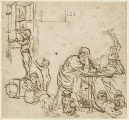 Everything about the this ink drawing surprised me except for how good it is. Adam Elsheimer (1578--1610) is known for his paintings on copper--not canvas or panel. They are usually small and often night scenes like the Flight into Egypt below. Always they are arresting; walking through a gallery and coming on one of these paintings, it is as if the museum's wall had suddenly opened up and I am looking directly into luminous, poetic Elsheimer's 's imagination. I am drawn deeper in and I like every minute of it. The drawing of "The Artist Despairing of his Poverty," took me somewhere less alluring but more compelling if also disturbing.