
In my eyes there is only one art—not high or low; not fine or decorative. Paintings, sculpture, furniture, ceramics, jewelry, textiles, embroideries, glass—I look at and care about much of this; the people who make or made it and those who collect and sell it--those are my targets. [AS FOR POSTS: MY TARGET FOR THAT IS WEEKLY FROM FRIDAY TO MONDAY.]
Tuesday, 18 December 2012

Thursday, 6 December 2012
Dying for art
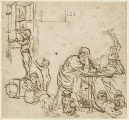 Everything about the this ink drawing surprised me except for how good it is. Adam Elsheimer (1578--1610) is known for his paintings on copper--not canvas or panel. They are usually small and often night scenes like the Flight into Egypt below. Always they are arresting; walking through a gallery and coming on one of these paintings, it is as if the museum's wall had suddenly opened up and I am looking directly into luminous, poetic Elsheimer's 's imagination. I am drawn deeper in and I like every minute of it. The drawing of "The Artist Despairing of his Poverty," took me somewhere less alluring but more compelling if also disturbing.

Drawn in ink when artist was about 25 years old this portayal of an artist bent over his work table while his child and the family pets scrounge around looking of a crust of bread, The composition is well judged; the lines confident and fluent which made the subject somehow more unnerving. It is very likely autobiographical; a work of art like the paintings but not so entirely a work, also, of the imagination. Elsheimer was only 34 when he died-- famous and borderline broke.
There are lots of good show in New York right now. The Metropolitan Museum of Art alone has Bellows and Matisse (both of which I've written about for The Economist.) I very nearly didn'tgo to see the show Old Master drawings from Munich at the Morgan Library and Museum. There just wasn't time. But someone who did told me I shouldn't miss it. When it comes to art, unlike many other things, I almost always listen to my husband's advice, so on the day we were flying back to London, I cycled up to the Morgan. It is a fantastic show.
With all the carrying on about last night's Sotheby's auction of a Raphael drawing for a hammer price of 29.5 million pounds you might think Raphael only did one or two. Dürer to de Kooning: 100 Master Drawings from Munich at the Morgan includes works often arresting works by Rembrandt, Rubens, Michaelangelo and Van Gogh. Things works are seldom on view. It probably is the one show in town not to be missed. Of all the treasures in it, it is the moving self-portrait of Elsheimer in despair that most moved me and stays all to clearly in my mind. When it comes to making art or trying to, despair is no stranger even when you have the money for the rent.
Thursday, 22 November 2012
Toys for a queen's inner child

 |
| Father |
Furniture can be sexy. Who would have thought. Also it can be gorgeous, exquistely made, magical and hardest for some to believe, a work of art.. Exhibitions of furniture are usually worthy, which is to say instructive and dull. This one is anything but. “Extravagant Inventions: The PrincelyFurniture of the Roentgens,” now at the Metropolitan Museum of Art is an
unexpected treat. The woods –sycamore, rosewood,
apple among them are warm and beautiful. The inlaid marquetry is as good as it
gets with perfectly inset flowers, cherubs, comedia dell’arte figures, historical
scenes and plenty else besides--let's not forget cows. But best
of all are the secrets. Marie Antoinette and Catherine the Great were patrons of the Roentgens. These desks and chests, chairs, cabinets and caskets all practical objects, are also princely toys. Turn a
gilded key in a door of a cabinet and it springs opens to reveal boxes that
open out to reveal many hidden drawers; the
sides of a desk springs open to reveal
slanting stands on which to rest heavy books like illuminated manuscripts and
on it goes with parts of the furniture sliding, jumping out, turning and springing..
 |
| Son |
 |
| Before |
 |
| after |
Not surprisingly for a writer, my favorite is a writing desk designed by Abraham Roentgen. In fact, this loan from the Rijksmuseum, is encrusted with such fanciful, luscious inlay it probably made anything its
owner wrote seem feeble in comparison. A dozen woods from walnut to olive were
used, some of them stained. Tortoiseshell, mother-of-pearl, ivory, gilded
bronze, brass, copper and silver were used for the inlays There are coats of
arms of the von Wallendorfs who commissioned the piece. There are also putti
and flowers, Charity and Justice makes appearances as do evocations of black
and white tiled rooms and-- at the side-- pastoral scenes with flute playing
farmer and munching cows.. Just about every part of this desk springs open to
reveal more drawers and niches; the base becomes a knee- rest for praying and the
top turns into a small altar.(The von Wallendorfs were Catholic.)
The exhibition
which took three years to organize, is the outgrowth of the passion for the
Roentgens which Met curator Wolfram Koeppe has had since his student days. I wrote a profile of Koeppe for 25 years of TEFAF published last March. He has learned huge amounts since his student days but has never lost his love for European works of art. Lucky us.
Wednesday, 7 November 2012
Eat your spinach, Prince Charles.
It is all very well to be heir to the
throne of England, but if you want to be remembered you had better stick around
and get yourself crowned. This is the message I took home from “The LostPrince,” the handsome exhibition now at London’s National Portrait Gallery. The fact that there ever was a Henry, Prince of Wales--the youth who is the subject of this show (see below with his sword)--comes as a surprise to lots of people, as its title telegraphs. .
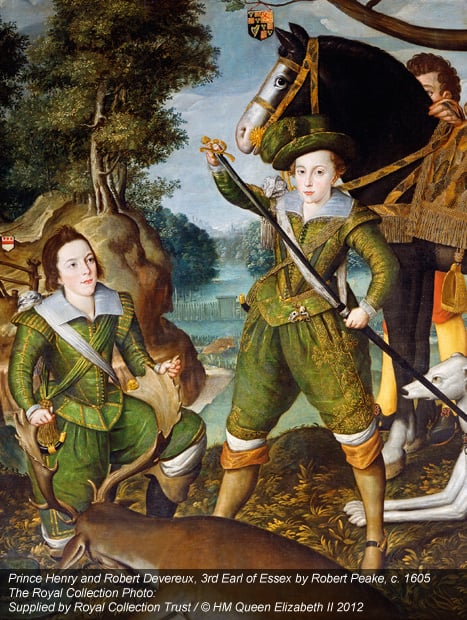
Born in 1594, Henry was the son and heir of King JamesVI of Scotland and I of England and his consort Anne of Denmark, He seems to have been a
golden lad, much loved by those at court and it the populace. Even his younger brothers is said to have adored him although no evidence in support of this dubious claim is advanced. In 1612,
when Henry, Prince of Wales died of typhoid at the age of eighteen, the
procession to Westminster Abbey was made up of over 2,000 official
mourners—hundreds more than had accompanied the body of Queen Elizabeth nine
years before. “Multitudes” lined the streets. Musicians composed mourning
music; poets wrote elegies. With all that, no monument was erected to the youth who-- had he outlived his father-- would have been King Henry IX. Today, even
well-educated, gray haired English people who went to school when children
still learned history never have heard of him. So with all its portraits and letters, books and maps this is an enlightening as
well as an enjoyable show. It certainly provokes thoughts about “what might have been?” Henry’s
younger brother Charles became the heir. Charles I was a great art collector but an
unpopular, misery- making king who waged and lost two civil wars and was executed.
Tuesday, 30 October 2012
Never to old to be loved
I picked up the ancient Roman bronze and immediately felt in close contact with a beauty 2000 years old. The past was no longer a stranger; now we were friends. I've admired many old objects and art works but never had I felt such comraderie before. It happened like this.
 The viewing at Christie's South Kensington was for its October 25th Antiquities sale. I was especially interested in the glass cases displaying rings from the Jurgen Abeler collection. The jeweller and goldsmith died in 2010 and his heirs were selling his collection of more than 500 rings. I like old rings and he had lots of them. Most of the rings had already been sold in the October 9 South Ken jewellery sale but forty ancient ones had been held back for this one. I looked at the Egyptian, Greek, Roman and Byzantine ornaments but my eyes kept going back to the hand--the only non jewel being sold from Abeler's collection. It was blackened bronze; the sculptor had paid a lot of attention to it. The fingers of this female hand were expressive; nails and finger tips, too. The catalogue entry placed it between the 1st century B.C. and the !st c
century A.D. I asked the woman behind the counter if I could have a closer look. She reached in, took out the hand and placed it on the glass cabinet. I picked it up. The fit of the Roman hand in my own was just right. Holding this hand couldn't have felt more natural. It seemed to belong there. The estimate read £1200--£1500. It was a lot of money for me to spend on an ancient fragment; something that would sit on my desk as if it were a paperweight and soon be lost under the ever replenished sheets of paper. (The paperless revolution has yet to make its presence known in my study.)
I hated to give up the hand and with it this never before felt direct contact with the ancient past. I wanted it. I would go for it!
In the days before the auction I tried to talk myself out of bidding. I am not an antiquities collector. £2000 is not small change. I had an appointment I could not change. I wouldn't be able to go to the sales room. So...I registered for on-line bidding. I'll skip over the technical problem that resulted in the auctioneer's voice getting knocked out. Christie's shifted me to telephone bidding. The action was slow--it always is when there are telephone bidders who have to be told what is happening in the salesr oom and then by the time they decide whether or not to go another round someone has beat them to it and the discussion seems to start all over again. Lot 210 finally came up. My new friend's hand. Suddenly time speeded up. The numbers jumped and leapt up. £6000 was bid in what felt like 20 seconds. With Christie's commission and other charges, that meant £7500. I never had a chance to bid and I certainly was not going to begin now.
Goodbye my friend.
I picked up the ancient Roman bronze and immediately felt in close contact with a beauty 2000 years old. The past was no longer a stranger; now we were friends. I've admired many old objects and art works but never had I felt such comraderie before. It happened like this.
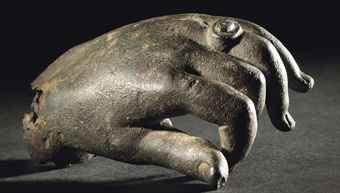 The viewing at Christie's South Kensington was for its October 25th Antiquities sale. I was especially interested in the glass cases displaying rings from the Jurgen Abeler collection. The jeweller and goldsmith died in 2010 and his heirs were selling his collection of more than 500 rings. I like old rings and he had lots of them. Most of the rings had already been sold in the October 9 South Ken jewellery sale but forty ancient ones had been held back for this one. I looked at the Egyptian, Greek, Roman and Byzantine ornaments but my eyes kept going back to the hand--the only non jewel being sold from Abeler's collection. It was blackened bronze; the sculptor had paid a lot of attention to it. The fingers of this female hand were expressive; nails and finger tips, too. The catalogue entry placed it between the 1st century B.C. and the !st c
century A.D. I asked the woman behind the counter if I could have a closer look. She reached in, took out the hand and placed it on the glass cabinet. I picked it up. The fit of the Roman hand in my own was just right. Holding this hand couldn't have felt more natural. It seemed to belong there. The estimate read £1200--£1500. It was a lot of money for me to spend on an ancient fragment; something that would sit on my desk as if it were a paperweight and soon be lost under the ever replenished sheets of paper. (The paperless revolution has yet to make its presence known in my study.)
I hated to give up the hand and with it this never before felt direct contact with the ancient past. I wanted it. I would go for it!
In the days before the auction I tried to talk myself out of bidding. I am not an antiquities collector. £2000 is not small change. I had an appointment I could not change. I wouldn't be able to go to the sales room. So...I registered for on-line bidding. I'll skip over the technical problem that resulted in the auctioneer's voice getting knocked out. Christie's shifted me to telephone bidding. The action was slow--it always is when there are telephone bidders who have to be told what is happening in the salesr oom and then by the time they decide whether or not to go another round someone has beat them to it and the discussion seems to start all over again. Lot 210 finally came up. My new friend's hand. Suddenly time speeded up. The numbers jumped and leapt up. £6000 was bid in what felt like 20 seconds. With Christie's commission and other charges, that meant £7500. I never had a chance to bid and I certainly was not going to begin now.
Goodbye my friend.
Tuesday, 16 October 2012
Red faced at Frieze
What a hang over and I wasn't even drinking. Last week there was Frieze, the
Regent’s Park contemporary fair launched in Regent’s Park in 2003 and now a world famous destination and
not far away its new sibling--Frieze Masters showing painting, sculpture and
works on paper with a pre2000 dateline. Across town, and overlapping with the
Friezes, was the sixth edition of the design and art fair PAD in leafy Berkeley Square.
What with the contemporary art auctions, gallery
openings and launches of new spaces as well as parties  some nights four or five of them, art lovers are now catching up on sleep. I enjoy the memories--many of them recollections of art that moved me--Josef Koudelka's photographs above all--one of which is how hot my cheeks got when this viewer and the art on view couldn't have been more of a mismatch.
Frieze London (as the contemporary fair has
been rebranded since May's successful launch of Frieze New York on Randall's Island) is not my natural habitat. However I went along last Saturday, chiefly to see an old friend in from Berlin. I had skipped the last few editions of the fair ("keeping up" had diminishing returns) and was surprised to find it looking more like a display of art as I know it rather than the emptied contents of a bag ladies stash. Outstanding was the booth of the Tokyo's Taka Ishii Gallery showing photographs by Yuki Kimura. The place was as crowded as Oxford
Street at Christmas; hot and airless. I got thirsty fast, Good luck, I thought, when I saw the wheeled
trolley in an aisle outside a gallery. On it was a stacked of paper cups (advertising TATE.in white dots against sky blue), sugar packets and wooden sticks for stirrers. Coffee was sure to be in a spigot at
the side. I picked up a cup but before I could pour a man suddenly materialized: “Do not
touch the art,” he said severely. I blushed and laughed. As I was in need of refreshment rather than a
concept I left that tent and headed for Frieze Masters a twenty minute walk through the park.
There at least one visitor was as out of synch with the art on view as I had been at Frieze London.
The Pace Gallery stand displayed an Alexander Calder mobile. A man came up to have a look. One of the staff chatted with him, explaining that Calder was the first to invent the mobile. The fellow looked puzzled. He turned his gaze from her and stared at the phone in his hand.
I heard the above anecdote from a trustworthy source who heard it from someone at Pace. When I tried to confirm at the gallery, I heard only, "I don't know anything about it," Well at least my mistaking coffee cups for art is not an apocryphal tale. And I think thinking that Calder invented the mobile phone isn't one either.
As for Frieze Masters about which I'm blogging at Prospero at economist.com tomorrow, it survived the huge publicity blitz and the theorizing which put me off when I was first subjected to it. (see previous post.) It joins TEFAF in March as a fair I won't want to miss.
Open the champagne and turn on the desk lamp
Procrastinators and scholars have a lot to celebrate. (I do not mean to suggest that it is impossible to be both.) On October 11, the Metropolitan Museum of Art announced its latest and in my view greatest on line undertaking since Thomas P. Campbell became director two years ago. A project to make available all its publications dating from its founding in 1860 is under way. The first stage, now completed includes 650 published since 1964. Included are exhibition catalogues like the one below


and books of widespread general interest like the Guide to the Museum above. There are subjects that suddenly have a previously unsuspected fascination like this one about the Art of Medicine in Ancient Egypt. Come to think of it, it never occurred to me that such an art existed but how it easy it will be now to explore on of my many areas of ignorance. Indeed, this project is like a map to unexplored territories.

There are manuals for educators that may prove to be useful for journalists who don't want to live on a Wiki diet exclusively. This one on Korean art looks particularly inviting.

And think of the information and image packed specialist books focusing on the museum's world famous collections that now will be a click away like this one on the sculpture of Gandhara

Additions to titles available on line will continue to roll out including Met Bulletins and out of print books.
Thanks to Tom Campbell and to Hunt and Betsy Lawrence sponsors of this project, hundreds of hours of day dreaming and learning are ahead.
and books of widespread general interest like the Guide to the Museum above. There are subjects that suddenly have a previously unsuspected fascination like this one about the Art of Medicine in Ancient Egypt. Come to think of it, it never occurred to me that such an art existed but how it easy it will be now to explore on of my many areas of ignorance. Indeed, this project is like a map to unexplored territories.
There are manuals for educators that may prove to be useful for journalists who don't want to live on a Wiki diet exclusively. This one on Korean art looks particularly inviting.
And think of the information and image packed specialist books focusing on the museum's world famous collections that now will be a click away like this one on the sculpture of Gandhara
Additions to titles available on line will continue to roll out including Met Bulletins and out of print books.
Thanks to Tom Campbell and to Hunt and Betsy Lawrence sponsors of this project, hundreds of hours of day dreaming and learning are ahead.
Subscribe to:
Posts (Atom)