Thursday, 22 November 2012

Toys for a queen's inner child


Media image

Father
Furniture can be sexy. Who would have thought. Also it can be gorgeous, exquistely made, magical and hardest for some to believe, a work of art..  Exhibitions of furniture are usually worthy, which is to say instructive and dull. This one is anything but.  “Extravagant Inventions: The PrincelyFurniture of the Roentgens,” now at the Metropolitan Museum of Art is an unexpected treat. The woods –sycamore, rosewood, apple among them are warm and beautiful. The inlaid marquetry is as good as it gets with perfectly inset flowers, cherubs, comedia dell’arte figures, historical scenes and plenty else besides--let's not forget cows. But best of all are the secrets. Marie Antoinette and Catherine the Great were patrons of the Roentgens. These desks and chests, chairs, cabinets and caskets all practical objects, are also princely toys. Turn a gilded key in a door of a cabinet and it springs opens to reveal boxes that open out to reveal many hidden drawers;  the sides of a desk  springs open to reveal slanting stands on which to rest heavy books like illuminated manuscripts and on it goes with parts of the furniture sliding, jumping out, turning and springing..
Son

Media image
Before
  The sixty pieces on view all made by in the eighteenth century by Abraham and his son David Roentgen and their team at their workshop in Neuwied, German  This is the largest show of Roentgen furniture ever staged in the United States. Unprecedented loans have come from private and public collections at home and abroad including six pieces never before loaned by Berlin’s Kuntsgewerbe Museum. Here, the use of videos doesn’t seem merely an attempt to appear to be up to date technologically. It helps. As soon as I figure out how to add the vidoes to this post I will. For now go to the Met's website. They show  several pieces being opened.. Alongside the Roentgens’ sizeable “Automaton of Marie Antoinette” of a large, doll-sized queen sitting at her dulcimer, is a video of what happens when the piece is wound up. The full skirt of her gown hides the mechanism that directs beauty to turn her bewigged head as if bemused by the music she makes as she strikes the keyboard . The lovely sounds fill the galleries providing just a touch of eighteenth century atmosphere—a touch is quite enough. Often at exhibitions I feel that paintings mean most when hung at home on the wall and that there is always a loss when seeing them in public exhibitions. But here, displayed in the museum the power as well as the spectacular attractiveness and craftsmanship of Roentgen pieces shines out more than one any single one I've seen does when on show in a museum period room.
 Extravagant Inventions: The Princely Furniture of the Roentgens
after
  Not surprisingly for a writer, my favorite is a writing desk designed by Abraham Roentgen. In fact, this loan from the Rijksmuseum, is encrusted with such fanciful, luscious inlay it probably made anything its owner wrote seem feeble in comparison. A dozen woods from walnut to olive were used, some of them stained. Tortoiseshell, mother-of-pearl, ivory, gilded bronze, brass, copper and silver were used for the inlays There are coats of arms of the von Wallendorfs who commissioned the piece. There are also putti and flowers, Charity and Justice makes appearances as do evocations of black and white tiled rooms and-- at the side-- pastoral scenes with flute playing farmer and munching cows.. Just about every part of this desk springs open to reveal more drawers and niches; the base becomes a knee- rest for praying and the top turns into a small altar.(The von Wallendorfs were Catholic.)
   The exhibition which took three years to organize, is the outgrowth of the passion for the Roentgens which Met curator Wolfram Koeppe has had since his student days. I wrote a profile of Koeppe for 25 years of TEFAF published last March. He has learned huge amounts since his student days but has never lost his love for European works of art. Lucky us.

Wednesday, 7 November 2012


Eat your spinach, Prince Charles.   

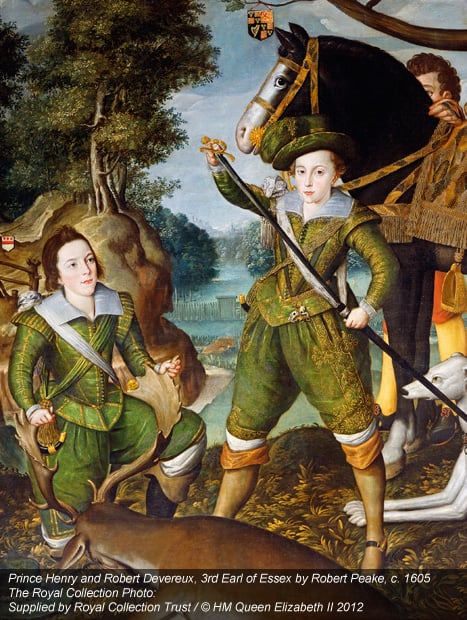
It is all very well to be heir to the throne of England, but if you want to be remembered you had better stick around and get yourself crowned. This is the message I took home from “The LostPrince,” the handsome exhibition now at London’s National Portrait Gallery. The fact that there ever was a Henry, Prince of Wales--the youth who is the subject of this show (see below with his sword)--comes as a surprise to lots of people, as its title telegraphs. .  


 Born in 1594, Henry was the son and heir of King JamesVI of Scotland and I of England and his consort Anne of Denmark, He seems to have been a golden lad, much loved by those at court and it the populace. Even his younger brothers is said to have adored him although no evidence in support of this dubious claim is advanced. In 1612, when Henry, Prince of Wales died of typhoid at the age of eighteen, the procession to Westminster Abbey was made up of over 2,000 official mourners—hundreds more than had accompanied the body of Queen Elizabeth nine years before. “Multitudes” lined the streets. Musicians composed mourning music; poets wrote elegies. With all that, no monument was erected to the youth who-- had he outlived his father-- would have been King Henry IX. Today, even well-educated, gray haired English people who went to school when children still learned history never have heard of him. So with all its portraits and letters, books and maps this is an enlightening as well as an enjoyable show.  It certainly provokes thoughts about “what might have been?”  Henry’s younger brother Charles became the heir. Charles I was a great art collector but an unpopular, misery- making king who waged and lost two civil wars and was executed.  
  

Tuesday, 30 October 2012

Never to old to be loved


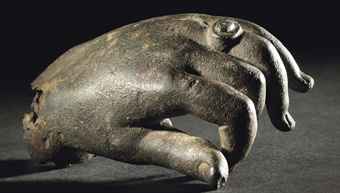
I picked up the ancient Roman bronze and immediately felt in close contact with a beauty 2000 years old. The past was no longer a stranger; now we were friends. I've admired many old objects and art works but never had I felt such comraderie before. It happened like this.
A ROMAN BRONZE FEMALE LEFT HAND     The viewing at Christie's South Kensington was for its October 25th Antiquities sale. I was especially interested in the glass cases displaying rings from the Jurgen Abeler collection. The jeweller and goldsmith died in 2010 and his heirs were selling his collection of more than 500 rings. I like old rings and he had lots of them. Most of the rings had already been sold in the October 9 South Ken jewellery sale but forty ancient ones had been held back for this one. I looked at the Egyptian, Greek, Roman and Byzantine ornaments but  my eyes kept going back to the hand--the only non jewel being sold from Abeler's collection. It was blackened bronze; the sculptor had paid a lot of attention to it. The fingers of this female hand were expressive; nails and finger tips, too. The catalogue entry placed it between the 1st century B.C. and the !st c
century A.D. I asked the woman behind the counter if I could have a closer look. She reached in, took out the hand and placed it on the glass cabinet. I picked it up. The fit of the Roman hand in my own was just right. Holding this hand couldn't have felt more natural. It seemed to belong there. The estimate read £1200--£1500. It was a lot of money for me to spend on an ancient fragment; something that would sit on my desk as if it were a paperweight and soon be lost under the ever replenished sheets of paper. (The paperless revolution has yet to make its presence known in my study.)
   I hated to give up the hand and with it this never before felt direct contact with the ancient past. I wanted it.  I would go for it!
    In the days before the auction I tried to talk myself out of bidding. I am not an antiquities collector. £2000 is not small change. I had an appointment I could not change. I wouldn't be able to go to the sales room. So...I registered for on-line bidding. I'll skip over the technical problem that resulted in the auctioneer's voice getting knocked out. Christie's shifted me to telephone bidding. The action was slow--it always is when there are telephone bidders who have to be told what is happening in the salesr oom and then by the time they decide whether or not to go another round someone has beat them to it and the discussion seems to start all over again. Lot 210 finally came up. My new friend's hand. Suddenly time speeded up. The numbers jumped  and leapt up. £6000 was bid in what felt like 20 seconds. With Christie's commission and other charges, that meant £7500. I never had a chance to bid and I certainly was not going to begin now.
    Goodbye my friend.

Tuesday, 16 October 2012

Red faced at Frieze


What a hang over and I wasn't even drinking. Last week there was Frieze, the Regent’s Park contemporary fair launched in Regent’s Park in  2003 and now a world famous destination and not far away its new sibling--Frieze Masters showing painting, sculpture and works on paper with a pre2000 dateline. Across town, and overlapping with the Friezes, was the sixth edition of the design and art fair PAD  in leafy Berkeley Square.
 What with the contemporary art auctions, gallery openings and launches of new spaces as well as parties Frieze London 2012some nights four or five of them, art lovers are now catching up on sleep. I enjoy the memories--many of them recollections of art that moved me--Josef Koudelka's photographs above all--one of which is how hot my cheeks got when this viewer and the art on view couldn't have been more of  a mismatch.
      Frieze London (as the contemporary fair has been rebranded since May's successful launch of Frieze New York on Randall's Island) is not my natural habitat. However I went along last Saturday, chiefly to see an old friend in from Berlin. I had skipped the last few editions of the fair ("keeping up" had diminishing returns) and was surprised to find it looking more like a display of art as I know it rather than the emptied contents of a bag ladies stash. Outstanding was the booth of the Tokyo's Taka Ishii Gallery showing photographs by Yuki Kimura.  The place was as crowded as Oxford Street at Christmas; hot and airless. I got thirsty fast, Good luck, I thought, when I saw the wheeled trolley in an aisle outside a gallery. On it was a stacked of paper cups (advertising TATE.in white dots against sky blue), sugar packets and wooden sticks for stirrers. Coffee was sure to be in a spigot at the side. I picked up a cup but before I could pour a man suddenly materialized: “Do not touch the art,” he said severely. I blushed and laughed. As I was in need of refreshment rather than a concept I left that tent and headed for Frieze Masters a twenty minute walk through the park.Romano Alberti da San Sepolcro: Pair of kneeling candle stick angels. Bacarelli Botticelli, Florence   

 There at least one visitor was as out of synch with the art on view as I had been at Frieze London.
   The Pace Gallery stand displayed an Alexander Calder mobile. A man came up to have a look. One of the staff chatted with him, explaining that Calder was the first to invent the mobile. The fellow looked puzzled. He turned his gaze from her and stared at the phone in his hand. 
    I heard the above anecdote from a trustworthy source who heard it from someone at Pace. When I tried to confirm at the gallery, I heard only, "I don't know anything about it," Well at least my mistaking coffee cups for art is not an apocryphal tale. And I think thinking that Calder invented the mobile phone isn't one either.
  As for Frieze Masters about which I'm blogging at Prospero at economist.com tomorrow, it survived the huge publicity blitz and the theorizing which put me off when I was first subjected to it. (see previous post.) It joins TEFAF in March as a fair I won't want to miss.   

Open the champagne and turn on the desk lamp

Procrastinators and scholars have a lot to celebrate. (I do not mean to suggest that it is impossible to be both.) On October 11, the Metropolitan Museum of Art announced its latest and in my view greatest on line undertaking since Thomas P. Campbell became director two years ago. A project to make available all its publications dating from its founding in 1860 is under way. The first stage, now completed includes 650 published since 1964. Included are exhibition catalogues like the one below
American Art Posters of the 1890s in The Metropolitan Museum of Art, including the Leonard A. Lauder Collection


and books of widespread general interest like the Guide to the Museum above. There are subjects that suddenly have a previously unsuspected fascination like this one about the Art of Medicine in Ancient Egypt. Come to think of it, it never occurred to me that such an art existed but how it easy it will be now to explore on of my many areas of ignorance. Indeed, this project is like a map to unexplored territories.

The Art of Medicine in Ancient Egypt

                       
    There are manuals for educators that may prove to be useful for journalists who don't want to live on a Wiki diet exclusively. This one on Korean art looks particularly inviting.
             
       
And think of the information and image packed specialist books focusing on the museum's world famous collections that now will be a click away like this one on the sculpture of Gandhara


Additions to titles available on line will continue to roll out including Met Bulletins and out of print books.
Thanks to Tom Campbell and to Hunt and Betsy Lawrence sponsors of this project, hundreds of hours of day dreaming and learning are ahead.

Friday, 27 July 2012


Ask a Silly Question at the British Museum


“What were people thinking about when they went to the GlobeTheatre to see the latest Shakespeare plays?” 

 This question posed by a member of the Royal Shakespeare Company gave NeilMacGregor, director of the British Museum, the idea for  “Shakespeare: Staging the World,” which just opened. It is widely agreed that MacGregor is an intelligent, erudite fellow but whatever made him think such a dopey question could serve as the armature for a major exhibition. A bookish show of diaries or essays by articulate, self-aware playgoers might have had a shot. Without them, the result was likely to be a lot of hot air.  And that is what this vaunted collaboration between the BM and the RSC turns out to be.  
    Actors have a well documented adoration for their own words but, usually, they aren’t altogether rewarding to listen in on. But terrific actors reciting Shakespeare now that is a very different thing.  In what the BM calls “a series of new digital interventions,”—video clips to you and me—provide... HarrietWalter speaks as Cleopatra, Sir Antony Sher as Shylock, Sir Ian McKellan as Prospero and Paterson Joseph as Brutus. I fear it sounds ungrateful but the result was irritating rather than inspiring. These performers and their declaiming kept popping up out of the dark as I crept around  trying to figure out what the 200 or so paintings and objects were going to tell me about Shakespeare. (I wasn’t expecting illumination about the preposterous conceit of reading theatre goers minds.) Very soon I felt all the theatrics were so much noise. What a waste.  
   As for the objects themselves…  Barbari,Jacopo de. Canale Grande, Map of Venice (ca. 1500). Jacopo de’Barbari’s vast woodcut map of Venice (1.3 x 2.8) is always terrific to look at with its steeple top view of every house, convent, church and garden in the city. It was published in 1500; Shakespeare was born more than 60 years later. Okay, call this a quibble. How about this one: Shakespeare set plays in beautiful Venice but he never actually went there. So why this map? Even if he had been there what would this map tell us about his reaction to it? Most London playgoers would not have been to Venice, either. I enjoyed studying the map and I think most anyone who’s been lost in the city’s maze of alleys will, too. It is fun to see what has changed and how much has not. I always play the ridiculous came of trying to find the palace where I was lucky enough to live even though I know that I won’t find it. It is on the Fondamenta Nuove which was made from landfill after de’Barberi drew his map.
   Neil MacGregor is an historian with strong religious commitment. His best exhibitions reflect this. The First Emperor and Hadrian were terrific. So was the beautiful show about reliquaries or holy jewels as I think of them. (Here are links to my Economist review of both: FirstEmperor; Treasures of Heaven.)  Shah ‘Abbaswas a nightmare for me. The relatively few objects on view were treasures that were meant to introduce a neophyte like me to the Persian ruler’s importance. The carpets were fabulous but all I learned was that a rich, powerful, ambitious Muslim gave expensive gifts to important religious sites; a practice well known among similarly powerful Christians and Jews. I got a headache trying to find something to say in the Economist story I was committed to write. Thankfully I eventually had a brain wave; I ignored the exhibition and instead compared the portrait of Robert Shirley in it with another large portrait of the Englishman on view in the Van Dyke then at Tate Britain. (At BM below with his wife.)  If I learned almost nothing from the Shah ‘Abbas exhibition, I learned less from “Shakespeare: Staging the World.”        

Thursday, 17 May 2012


I don't write about contemporary art but exceptions are the rule here as every place else.                  
                                                       * * * *
Cloth installation at Palazzo Fortuny, Venice, 2007, as part of the exhibition ‘Artempo - Where Art Becomes Time’ (Courtesy October Gallery, London)

El Anatsui makes beautiful and covetable works of art out of used, metal whiskey bottle caps. Below is a profile I wrote about him which appeared in Intelligent Life magazine in Winter 2009. I've made a few cuts to remove mention of information that is now out of date. Next week, May 21, Bonham's on Bond Street in London is holding an African Art auction and one of El's metal tapestries leads the sale with an estimate of $500---£800,000.  If you catch new Schiaperelli/Prada show at the Metropolitan Museum of Art's Costume Institute have a look at the Prada dress with a big skirt made out of "African bottle caps" --clearly inspired by El's work although not credited to him. (Better yet, visit the Met's African art gallery nearby and see the real thing.)
 
                                                    * * * *

The art world is waking up to the brilliance of El Anatsui, who weaves beauty out of bottle tops. paula weideger meets him

He’s the tops

El Anatsui, grey-haired and softly spoken, sat across from me on a black leather sofa in the lobby of a New York hotel. We had met to talk about his large and shimmering hangings. “I see myself as a person and an African,” he began. And indeed he was born in Ghana and since 1975 has taught and sculpted at the University of Nigeria, Nsukka until his retirement last year. He was quick to grasp what I was after when I asked a question but slow, sometimes very slow, to respond. The pauses between his words, between one sentence and the next, could be very long. It wasn’t that he was worried about saying the wrong thing. Although he is a modest man, he appears solidly self-confident. His pauses seemed to exist to create spaces in which he could think. “Professionally,” he finally added, “I see myself more as an artist in the world community of art.” So he is. But the world community of art took rather a long time to confirm his view. Fortunately, he wasn’t languishing.
Anatsui has “a huge reputation”, according to Chika Okeke-Agulu, a former student of his, now an art historian at Princeton. “He is one of the best-known names in (and I mean in the inside world of) contemporary Nigerian art. He is one of the leading figures associated with Nsukka School…arguably the most influential art school in Nigeria.” Lagos, an hour’s flight from Nsukka, has long had its own flourishing gallery scene and with that, active collectors. The novelist Chinua Achebe and the Nobel Laureate Wole Soyinka are among those who own Anatsui’s work. The October Gallery in London has been showing his work since the mid-1990s. In 2006 the Metropolitan Museum of Art in New York acquired one of his pieces for its African gallery. But it was only in 2007, aged 63, that Anatsui leapt into the heart of the wider art world. His springboard was the Venice Biennale, where he had exhibited in 1990, without making much impact.
Robert Storr, dean of the Yale Art School and director of the biennale, invited Anatsui to show two pieces in the Arsenale. Like all his current work, they were large hangings made of thousands of pieces of shimmering metal, stitched together with copper wire. They are astonishingly beautiful and not like anything done before. Some think of them as tapestries; Anatsui calls them sheets. It is common to hear them compared to Byzantine mosaics, but the differences are greater than the similarities.
Anatsui’s art is abstract. Colour, shape and light tell his story. In some pieces there are hundreds of dancing colours, while others are dominated by broad swathes of silver or gold or red. Unlike mosaics, these works are flexible; hanging free, they ripple as if they were cloth.
  Anatsui was the hit of that biennale. Of the pieces in the Arsenale, one was bought by Kansas City’s Nelson-Atkins Museum, the other for the Contemporary Collection of the Met. But his most talked-about work was a commission from the Belgian collector Axel Vervoordt for the Artempo installation at Palazzo Fortuny. “Fresh and Fading Memories, Part I-IV” was draped across the façade of this moody Gothic palace (picture above). Wire fastenings were undone to let light into the upper floors — adding to the loveliness of the piece, making the sumptuous fabric look ripped. Interest in Anatsui has been building ever since.


In October 2008 at Sotheby’s contemporary art sale in London, an Anatsui tapestry sold for $610,000, a world auction record for his work. (According to art-world gossip, one of his works has sold in the Middle East for over a million dollars. Vervoordt sold the Artempo piece, but will not disclose its price.) “Three Continents”, a dazzling 2.4 metres by 4.5 hanging, the outline of which resembles a Mercator projection, is priced at $700,000 at New York’s Jack Shainman gallery.  Commissions keep coming, including

“Fading Cloth” (2005), a typically shimmering piece by El Anatsuione for a 12 metres by 3.6 piece to hang in the atrium of the Bill and Melinda Gates campus in Seattle.
    “El Anatsui: When I Last Wrote to You About Africa”, his first major retrospective, will open at the Royal Ontario Museum in October 2010. In January 2013 after a two year dealy it will finally reach New York as the inaugural exhibition at the Museum for African Art. As well as organising the retrospective, the mfaa has co-produced a 53-minute documentary, “Fold Crumple Crush: The Art of El Anatsui” by Susan Vogel director of Columbia University Global Centres: Africa. It’s an engaging, informative and sensitive look at his way of life andof working.

In the film we see Anatsui at his local internet shop, doing his e-mail. We watch the rusty red earth kick up behind him as he heads for the shed of a seamstress who will sew packaging for him. And he takes us to the spot where he first came upon a bag of the bottle tops that are now central to his work.
Many African artists prefer to work with materials found near to hand. But just why were there thousands of bottle tops on Anatsui’s doorstep? The answer has to do with recycling. Drinkers return empty gin and whisky bottles to their local distiller, where they are refilled and given new caps. There is a keen market for the cast-offs. Melted down, they are transformed into cooking pots. Thirst being what it is, Anatsui has no trouble buying what he needs.

Some 20 men work on the hangings. They sit on the floor or hunch over tables in a large, open-plan studio. The round tops are cut out, the remaining aluminium is made into strips. Each element is pounded flat and pierced. Round ones are threaded together with round ones, strips with strips. Anatsui tells his crew what colour combinations he wants. These are then put together in sections, or units as he calls them. A unit might be two feet square or smaller.
“Working with the rings that hold the caps – that is very, very slow,” Anatsui says. “A few inches in a day. But when you work with the shaft of the cap that is very fast, because the basic unit is big.” Although he used to make preparatory drawings for his wood sculpture, he does no drawings for these pieces. “Now, I place things on the floor and move them around,” he says. “When I like where it is, it gets linked up. There are a lot of permutations all along the route.”
As the tapestry takes shape it begins to look like a giant jigsaw. But there is no pre-existing image. Even the artist may not know exactly what he’s looking for
>
“I am a nomad” El tells me. Since his retirement he has been making art and travelling the world inspecting sites and later installing his tapestries. Oh, and he's begun to commute regularly between Nsukka where he built a house overlooking the university and his homeland, Ghana.