
Sunday, 15 January 2017

Great show but not a great showing by the Met


JAR at the METROPOLITAN MUSEUM OF ART
from my archive; originally printed in The Economist

IN 1978 Joel Rosenthal, then a fledgling designer with a passion for gems, opened a small shop off Place Vendôme in Paris. He and Pierre Jeannet, his partner, named it JAR after the designer’s initials (his middle name is Arthur). Mr Rosenthal, who was born 70 years ago in the Bronx, says, “I wanted to fall flat on my own face or make my own name.”
He certainly succeeded in the latter. Mr Rosenthal is insistent that he had no powerful backer, either social or financial. Passers-by were not encouraged to drop in. The only publicity was word of mouth. Yet the famous and the rich soon found their way to his door, lured by the uniqueness of his creations.


The jeweller combs the world for quality gems, constantly expanding his range with unusual, even unfashionable stones, including green garnets, pink sapphires and black diamonds. His pieces are often unusually large and deeply three-dimensional. A brooch of two life-size, gem- laden lilacs is instantly recognisable as being by JAR. These are jewels for the chauffeured, not for those who need coats.
Mr Rosenthal has written that “beauty, art and luxury are inseparable from happiness.” His prices are not listed, though there are clues. In May 2012 Lily Safra, a philanthropist, auctioned 18 of her JAR pieces at Christie’s in Geneva in aid of charity. They fetched nearly $11.5m. Among them was a 37.2-carat diamond she had brought to Mr Rosenthal. “I can camouflage that,” said the charmer, who can also be blunt. He wrapped it in the twisting stem of two poppies made of pink and green tourmaline (pictured).
Eleven years after his only public show so far, at London’s Somerset House, Mr Rosenthal is about to become better known. Some 400 pieces are on view in “Jewels by JAR” at the Metropolitan Museum of Art. Many were made over the past decade and all are loans. This is the jeweller’s first American retrospective and the museum’s first display of “a contemporary artist in gems”. Tom Campbell, the director, believes people will see how the Met’s jewellery collection, which spans 2,000 years, has influenced Mr Rosenthal. In turn, JAR’s jewels will enable them to see the Met’s collection “with fresh eyes”.
These adornments and objets d’art, ranging from an amusing engraved bagel made of wood to a translucent amber pocket watch, occupy a single, spacious oval gallery. The walls are dark salmon in colour. The light is dim except inside the velvet-lined vitrines, which line the gallery’s perimeter and also stand freely within the central space. The effect is dramatic.
The pieces are loosely arranged by category: flowers, animals, sea life. There are plump ruby roses and camellias from a fairy-tale garden. In one small vitrine a flat-faced hellebore covered in diamonds and violet sapphires rests alongside its case—a round snowball made from a smoky rock-crystal studded with diamond snowflakes; apt for a flower that is also called the Christmas rose. In JAR-land even the ferns are pavéd in diamonds. Among the beasts, a soulful zebra-head brooch carved from agate wears a diamond halter and plumed headdress. The exhibition ends with a wall of butterfly brooches, each one larger-than-life-sized and closely set with intensely coloured gems—including fire opals, amethysts and garnets.
Mr Rosenthal wants visitors to look at his creations without being distracted by long explanatory captions or audio guides. This is effective; all attention is on the jewels. But the Met is not a shop where such a presentation would suffice. There ought to be a catalogue, for instance, with information about the rarity and source of the gems, comparisons with JAR’s most inventive contemporaries and comments from clients about commissions. Instead, the museum shop is offering only luscious picture albums (a short one with a biographical essay priced at $40 and a giant edition, which costs $800).
The museum deserves praise for exhibiting the work of an exceptional living jeweller, but not for letting him call the shots (even basic information, such as the size of the pieces, is missing). This is a sensational advertisement for JAR, as well as a fantastical, occasionally funny show, which is often very beautiful. For the visitor, that is both terrific—and not enough.

No price too high for fantasies


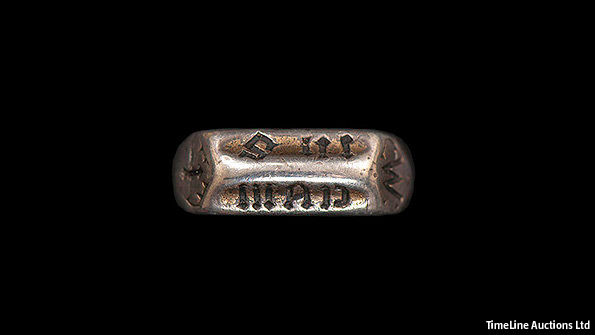
Purported to be a ring belonging to Joan of Arc
(From my archive; as originally published in the Economist.)

A MODEST, 15th-century silver ring for which an ambitious London dealer might ask £1,000 sold for an astonishing £297,000 at TimeLine Auctions on February 25th, a world auction record for a medieval European ring. There could not be a better example of the degree to which a stellar provenance affects the market value of an object: It was suggested, with the aid of documents sold with the ring, that the original owner of Lot 1220 was Joan of Arc, who led the French army against English invaders, a martyr and patron saint of France.
The high bidder was Puy du Fou, a history theme-park in central France created by Phillipe de Villiers. French media erupted in exclamation marks. Honour is saved! The ring is coming home! Hearts may swell and eyes tear; facts, however, remain. Or, perhaps, it is more accurate to say, an insufficiency of facts. There is a scarcity of the sort of archival evidence—wills, inventories, letters, diary entries—that scholars need to produce a solid provenance. And yet the conviction that Lot 1220 was Joan’s has taken hold. It is a tale in which politics, mistaken identity, passion, hope and mystery all play a part.
Joan was tried for heresy, found guilty and burned at the stake in 1431. During the interrogation which preceded this, in response to questions from Bishop Cauchon, the Maid of Orleans said that she had had two rings. The one given to her by her parents was by this time in the possession of the Burgundians, England's allies, who had caught her. On it were the names of Jesus and Mary and also, she thought, there were three crosses. The other ring, given to her by her brother, is not described. That wasn’t necessary, after all, since it was in the possession of her interrogators. After her death, that ring passed from Bishop Cauchon to the English Cardinal Henry Beaufort, who had been present at her execution. During the 500 years that followed there are no contemporary records of Joan of Arc’s rings. 
This changed in the early 20th century—a time when interest in Joan and her achievements, rekindled in the 19th century, was high; she was beatified in 1909. Lady Ottoline Morrell, a British aristocrat and a frequent hostess of the Bloomsbury group of writers, had a silver medieval ring she thought might have belonged to Joan. In time she gave it to Augustus John, a painter, who sold it in 1914. The first published association of the ring with Joan was three years later. Its then owner, F.A.H. Oates, included an illustration of it in the privately printed catalogue of his collection. It is the same ring as Lot 1220. Thirty years later, James Hasson, who owned it, commissioned a genealogy that traced Lady Ottoline’s ancestry back to Cardinal Beaufort. The name of the person in each generation who would have owned the ring was highlighted. Dr Hasson was reassured by this of the ring’s authenticity. The museums in France to which he loaned it seemed to agree. It was displayed as having been Joan of Arc’s. And yet a family tree by itself is not a widely accepted provenance. It might have been; it could have been; this does not mean it was. The new owner of Lot 1220 evidently was not deterred by this.
Nicolas de Villiers, son of Puy du Fou's founder and president of the theme-park today, concedes that the attribution is hard to believe. However, he was convinced that the ring is Joan's after a telephone conversation with Jacques Trémolet de Villers, a lawyer, monarchist and author whose works include an account of Joan of Arc's trial. During the call, which took place only days before the sale, Mr Trémolet pressed him to buy the ring which he said matched Joan's "precise" description of it—the three crosses and all. After hearing this, and acting on "instinct", Nicolas de Villiers decided to go for it. A 36–hour canvas of his rich friends produced the war chest for his successful bid. On March 20th, Joan of Arc's ring, the prize, will be unveiled to the public at the park. Or will it? 
There is no reason to believe that the ring with Jesus and Mary and the crosses that Joan described to Bishop Cauchon is the one he handed over to Cardinal Beaufort. There is no description to identify it. Well then, did the ring already possessed by the Burgundians, about which nothing more was recorded, suddenly reappear in the 20th century—effectively out of nowhere—and land in the jewellery box of Ottoline Morrell? No one can prove that it did not, of course. But neither has anyone proven that it did. What can be said is that some believe that it matches Joan’s description of her ring, closely, and that it is unique. Others, however, including the specialists consulted by this reporter, do not agree.
"I have yet to talk to a museum curator, an art dealer or an independent scholar who believes that the association with Jeanne d'Arc dates back to her lifetime," says Sandra Hindman, a medievalist, professor emerita at Northwestern University and dealer in medieval art and rings. "I personally believe that the attribution of the auctioned ring was part of the Jeanne d'Arc mania that begins in the 19th century and continues until about the mid-20th century." Her opinion was echoed by the other experts consulted by this reporter.
The attention given to the sale of Lot 1220 has brought international publicity to the auction house, which has posted a new video about it; its cataloguing of the ring as associated with the one given to Joan by her parents and later owned by Cardinal Beaufort remains unchanged. The theme-park has been widely publicised too. The vendor got far more for Lot 1220 than he expected. France bubbles with national pride, and may become even more joyful on hearing that the vanquished, next-highest bidder was Berganza, an English dealer. Politically, too, the ring is providing a boost: Joan of Arc is a particularly potent symbol for right-wing parties.
Indeed, some centrist and left-leaning Frenchmen feel that the Maid of Orleans, heroine of their schooldays, has been hijacked by the right. Every year on May 1st, the xenophobic and populist National Front gathers at her statue in Paris. Marine le Pen, its leader, tweeted "Thank you to @PhdeVilliers for bringing Joan of Arc's ring back to French soil." Was this a generous move, or a pre-emptive one? Philippe de Villiers is a leader of the Movement for France, a smaller rival to the National Front. Now his family appears to have won Joan of Arc for his followers. There is talk of national fundraising campaign to build a chapel at the theme park to house its precious relic. Whatever their politics, its millions of visitors will be awed. For many, it would seem, this tale has a happy ending—but not for all.

Vincent VanGogh Self Portrait of the Artist in Words and Images


The greatest autobiography of an artist

From my archives

An artist making art


THE story of Vincent van Gogh's life is more heartbreaking, and heart-lifting, than the romantic myth that has enshrouded him for decades. It is told, in his own words and works, in the six-volume “Vincent van Gogh: The Letters”. His 819 surviving letters (and the 83 addressed to him) form the core. The first letter was written when Vincent, aged 19, was a trainee at The Hague branch of Goupil & Cie, a firm of international art dealers. Like most of the letters, it was sent to his brother, Theo, then 15. The two remained close. Theo became an art dealer and Vincent's main source of financial and emotional support.
Van Gogh is irascible, engaging, intelligent, touchy, high-minded, well read, rebellious and pigheaded. When he started dressing like a tramp he claimed it was, in part, to advertise his refusal to join polite, ie, hypocritical society. (Equally, it may have been because polite society was refusing to accept him.) He was often miserable, occasionally love-struck, almost always fiercely committed to something or other and sometimes mad.


Art and literature were his constant companions. He wrote often about what he was reading and seeing. His concern was never a book's place in the canon or a painting's in art history. He judged a work on what it communicated, and how. From Antwerp he wrote that the religious paintings of Rubens are “theatrical…But what he can do is paint a queen, a statesman, well analysed, just as they are.” He wrote beautifully about landscapes and peasants. In time, he gave a vivid, perhaps unequalled, account of an artist making art.
He set off at 16, a seemingly conventional young man, to make his way as a dealer first in The Hague and then, via Paris, in London. There, a prickly instability, characteristic of his childhood, re-emerged, perhaps brought on by a rebuff from his landlady's daughter. He lost the job he had had for seven years. Other failures followed, as a preacher and a teacher.
His religious fanaticism grew. Indeed, the letters offer a rare look at obsession from the inside. His pursuit of a young widow was so unrelenting he would be called a stalker today. But to him, her repetition of “No, nay, never!” was “a piece of ice that I press to my heart to thaw.”
When he was 26 his fixation became art. By then he was a penniless, eccentric loner. This coincides with a year-long break in the correspondence. He had fallen out with Theo following a “discussion” about his future. When the letters resume, Vincent refers to himself as a prisoner, a caged bird. “I know I could be quite a different man!” he writes. “There's something within me, so what is it!” Two months later he bent himself to the study of drawing and painting as others would bend to the plough. It was as if he had to labour, and metaphorically sweat, before his genius could, or was allowed to, emerge. Five years later, in the spring of 1885, came “The Potato Eaters”. Movingly, triumphantly, van Gogh had broken through.
After two years in Paris, living with Theo (only nine letters; no images), Vincent moved to Arles in 1888. Colour now floods the pages. This was the beginning of the legendary period of prodigious, radiant creativity. Yes, he cut off his ear. He also painted nearly 200 pictures, among them “The Night Café” and “The Yellow House”.
In 1889, after a series of crack-ups (in reaction to Theo's marriage or perhaps just too much absinthe?), he spent a year in the asylum at Saint-Rémy-de-Provence. The work continued to pour out (about 150 paintings). Sunflowers and irises but also “Starry Night”, in which viewer and artist are pulled up over the rooftops, and tumble round and round across the dark sky.
The very last letter reproduced, addressed to Theo but unfinished, was written on July 23rd 1890. He was staying in Auvers-sur-Oise, not far from Paris where Theo lived with his wife and child. The note was found in Vincent's pocket after he shot himself. He died, aged 37, on July 27th.
Fifteen years were devoted to this publication. The Dutch, English and French editions are the joint project of the Huygens Institute and Amsterdam's Van Gogh Museum. Letters and illustrations fill five books; the sixth has commentaries, maps and indexes. It is all accessible, free, at www.vangoghletters.org (the site provides a valuable concordance). There is also a free iPod app, “Yours, Vincent”.
This is not the first attempt to publish the complete letters but it is the best. There were editions in 1914; an expanded version appeared in English in 1958; 20 newly discovered letters were added for the 1990 Dutch centenary edition. Now the letters have been retranslated, comprehensively annotated and there are 20 new items.
But what really sets this edition apart from, and above, all others are the illustrations. Sketches are embedded in many of van Gogh's letters; the drawings and “scratches” he sometimes tucked into envelopes before posting are reproduced. So are thumbnail illustrations of every work the artist mentions (whether by himself or by others) plus larger reproductions of paintings based on these letter sketches.
The Van Gogh Museum is marking the publication of the letters by rehanging its permanent collection and displaying 100 letters. (“Van Gogh's Letters: The Artist Speaks” closes on January 3rd.) On January 23rd a different exhibition opens at London's Royal Academy: “The Real Van Gogh: The Artist and his Letters”. More than 60 paintings and 35 drawings will come from across the world, closely related to the 40 letters that will be shown.
The publication of the six volumes is cause for celebration. To have all the artist's words together with all those images is like being given a pair of super-special 3D spectacles. The resulting self-portrait has a depth that would not exist were this a collection only of images or only of words. This could be the best autobiography of an artist yet to appear anywhere.

Monday, 19 December 2016

The delights and punchy surprises of Max Beckmann in New York


"Max Beckmann in New York," is a terrific unexpected show; see it before it closes on February 20 if you can, Tough and angry, packing a wallop yet somehow packing his images with life without ever breaking any bones

Plenty of shows feel like they are  cooked up by ambitious curators trying to find an angle, any angle, they can sell to a museum director. Not this one. Give or take a wee bit of padding it feels like the real thing. Beckmann and his wife Quappi found their anchor in New York. They'd been looking for one for a very long time.

He was a successful painter in his early fifties when the Nazis denounced Beckmann a degenerate artist. His work was removed from museums, dealers could not handle him. "Departure," above, his first triptych was started in 1933 and finished two years later. In a way it is like a visual, emotional rehearsal for the journey into exile he and his wife began when they set off for Amsterdam in 1937. He wanted to go to the US then but before that could be organized, war was declared and they were forced to stay in Holland. It was only on  November 2, 1949  (after two years teaching art in St. Louis) that they arrived to settle down in New York. "Babylon is a kindergarten by comparison," he said on a brief visit a couple of years before. This was not a criticism. On the contrary. It was just his "kind of thing."

Works managed to get out of Germany. He painted in Holland and St. Louis. Curt Valentin and J.B. Neumann, two German emigre dealers, succeeded in selling his pictures to collectors and museums.

This show is made up of loans from American collections along with works he did after he got to his ultimate home. His time in New York was productive; the works potent.  "Carnival Mask," (left) was painted in 1950; the year he also painted the self portrait in a blue jacket (above it).
 
"Self-Portrait in Blue Jacket," was one of the works exhibited in "American Painting Today," which ran at the Met from December 8, 1950 to February 21, 1951. A couple of days after Christmas Max Beckmann set out from his apartment across Central Park to get his first look at it and the show. He dropped dead of a heart attack on the corner of of West 69th and the Park.

Sabine Rewald, curator of this exhibition, writes that it this  "poignant" fact that inspired her to produce this show. The exhibition is proof that this is so. It is often moving as well as beautiful.


Wednesday, 30 November 2016

Gilding as Fine Art--about time too


The Frick Collection is staging the first in what will be  a years'- long series of special exhibitions devoted to the decorative arts. Pierre Gouthiere: Virtuoso Gilder at the French Court is sensational and a surprise

. Ornamented French 18th century furniture has begun on a high note--but also one that comes as a surprise at least to the non-expert in modelling, chasing and gilding objets d'art. Highly ornamented, fancy French 18th century furniture and objects always are opulent but most of them seem to inhabit an icy world;  Not here. What a relief and what a roll out of beauties.  Gouthiere was not only the most sought after, he was also the best. His creations commanded higher prices than those offered to most painters and sculptors. Fashions changed. "Off with their heads," was far from enough. Off, also,with their furniture, gardens, their taste.

I confess that while I knew that this stiff is thought to be exquisite I never much cared for it.  Or so I thought. What luck to be in New York to see  Gouthiere revived. Even the candelabra are exciting. The detail below from a pair in the exhibition are like beautiful jewels.  


The textures,light and shadows, the lyrical sweep grab attention and hold it. A treat and a joy. Paddle on over and join the swans in this show. There are a couple of terrific golden camels, too.

Detail of Gouthiere gilt-bronze pot-pourri vase with head of a swan

Tuesday, 8 November 2016

TEFAF:: MAASTRICHT OR NEW YORK?

Raining flowers in the Armory

TEFAF is a clunky word to stay but as an acronym it has luster because it stands for The European Fine Art Fair --the greatest art and antiques fair in the Western world. For decades it has taken place in Maastricht, the Netherlands every year in March.  The word "European" in its title is no longer entirely accurate however. Last month it opened its first satellite fair in New York. The US version will be in two parts: Fall, with 94 exhibitors, focuses on art and objects up to 1920; Spring--in May--will show art and objects since. (For reasons not entirely obvious High Jewellery--made today--is included in the Fall offering along with antique jewels that surely fall within its millennia long dateline.)
  I have been going to Maastricht for 12 years; I love it. There are always exciting surprises; there is always treasure to see. I travelled from London where I live to NY, where I am from,  expressly to see how this version would work in my hometown. The answer is it was a big success. The design almost completely transformed the armory into a light, airy and elegant space. The 11 upstairs rooms --some with original panelling--looked terrific and people did not hesitate to climb up to see what the dealers were offering. The presence of a champagne, oyster and salmon bar was also enticing. Axel Vervoordt--one of the dealers--could not have had a more perfect space if he'd built it all from scratch. 
  There were great things to see: The large 1531 map of the then known world (see below) by Visconte Maggiolo at Daniel Crouch Rare Books includes the first known topographical illustration of New York harbour. It has the fantastical, space- and time- travelling wonder of many early maps. Here,  North America for all the details of its eastern coastline is depicted as a long, skinny piece of land snaking its way between the Atlantic and Pacific Oceans. With a price of $10 million it is said to be the most expensive map offered on the public market. 
  Would I go again?  Yes, if I happened to be in NY when it was. I would not make a special trip. The fair fills two floors of the armory but it is only a third the size of Maastricht in March. With so much more variety there no wonder I like the Dutch version better. Also not surprising: Some of things I liked best in NY I'd already seen in Maastricht earlier this year. 
  This is a great fair for New York and people who can get to it with relative ease. It is the best fair of its type that  the city --and the whole country--has had for years if not forever.  Plenty of dealers say they sold well. Plenty of visitors looked thrilled. All good. I enjoyed it too. But it is March I look forward to. For years my heart has belonged to Maastricht and that has not changed.


Monday, 24 October 2016

This year in Jerusalem


Just go. Jerusalem: 1000-1400  Every People Under Heaven  at the Metropolitan Museum of Art is full of surprises and revelations that often are also beautiful objects and works of art. It turns out to be about as immersive and intense a museum experience as is a visit to that city in Israel-- if you leave out the on-the-spot uneasiness.  (Today, in Jerusalem, there is always the feeling that any minute, by chance, you are going to step on the toes of some religious Jew, Christian or Muslim who live and worship there--and that they are not going to take the injury quietly.) To judge by what I hope will be only the first exposure to this exhibition, visitors to it are engaged with the displays to an exceptional degree. To say that they scrutinize the works is an understatement. People don't just stroll through this one. They plant themselves in front of a case and don't move.  No sooner did I enter than I came upon a vitrine with this ornate parchment map written and drawn in England by Matthew Paris circa 1250.

The man standing in front of it wasn't going to budge so I settled to one side. It was as if he were planning a trip--or reviewing one he'd taken. The fact that the boat might have been different or that he probably had not travelled around the Holy Land by camel made not the slightest difference.  But it was in front of the open Chronicle by Moses Maimonides, the great Jewish philosopher, that I found myself part of a growing group of men, women and youths all discussing the text. First of course came the astonishment that this work written in the twelfth century survives. That any medieval document still exists is noteworthy to be sure. But even a brief consideration of the wanderings and tragedies of Jews in the centuries since makes the continued existence of this work on parchment a marvel. And then there very quickly was the question of its contents.  A woman in her forties began reading out loud from the text. Then one of her two sons--late teenagers I would guess--started amending and correcting. In the back stood dad..All the males wore black hats; pop alone had a beard. Mom's brown hair was a wig. They spoke Yiddish but the text of course was in Hebrew or whatever variant of same Maimonides used. The page on the left included a drawing. It was, I learned from their back and forthing was his reconstruction of the destroyed Temple. The older son began explaining that we were seeing it as from the entrance. Then a smartly dressed woman came along, listened in, read the label and asked: Does this mean that this book was actually written by Maimonides? Group discussion was followed by dispute. Pop who had been silent until now said quietly that he didn't believe it. "It would have been a scroll."  I went off to consult with a curator who was giving a talk nearby. She in turn quickly consulted with someone else/ Yes. Yes. Maimonides was not only the author it is in his own hand.  Displaying 38. Plan of the Temple-JPG_Original_300dpi.jpg

From Commentary on the Mishnah

At 5:15 were were told to leave; the Met was closing.  I walked out onto Fifth Avenue still enveloped in ancient Jerusalem and its descendant upstairs. A woman in her twenties stopped to ask directions. She had a French accent. She wore a scarf wrapped to hide her hair. "Where is the memorial to the dead?"she asked.
There are a couple of memorials that might fit the description--the Soldiers and Sailors for instance. But why in the world was she looking for that? I asked for more information. She tried one thing and another and finally, "September 11." 
    The World Trade Center," I told her, "is not near hear." I gave her instructions about how to find the subway station and where to get off. She smiled sweetly and thanked me. The show, precisely what it ought not to be called, goes on.