Sunday, 23 March 2014

Over the top? Over the Himalayas

What a trip across time and sensibilities. Within 36 hours in Paris I saw the Treasure of Naples at the Musee Maillol; "From Watteau to Fragonard; les fêtes galantes" at the Jacquemart-Andre and the Treasure of Saint- Maurice d'Agaune at the Louvre. First to Naples. Tomorrow to Watteau; the day after to the radiant medieval enamels from an ancient abbey in a Swiss mountain pass.

In New York in the fall I often went down to Little Italy for the Feast of San Gennaro. Inside the church on Mulberry Street a statue of the saint was covered in paper money. Outside in the courtyard spitting fat from cooking sausages fell onto the coals. (I was among the sausage eaters not the money- attachers.) Gennaro's congealed blood is kept in a reliquary in Naples' cathedral and taken out on feast days. During one such occasion in the the 14th century it started dripping. It has been dripping on most feasts days ever since. Plague came and pestilence and Vesuvius belched. The story goes that in the sixteenth century prayers to Bishop Gennaro--who had been martyred a millennium earlier--saved Naples from these threats. People thanked him lavishly and not only Neapolitans. But in recent years who knew that these treasures--the enormous silver statues, gold chalices and opulent jewels given to the people of Naples to celebrate their patron saint? Not many. Now for the first time 70 pieces-- said to be as valuable as England's Crown Jewels-- have left Italy and are on view in Paris. (There is airport style security entering and leaving.) To call these treasures over the top is feeble; over the Himalayas is more like it. It must have been raining emeralds over the Naples cathedral between the late 17th century well into the 19th when these pieces were made. The lagoon-clear Colombian emeralds, however, probably arrived in Europe with the Spanish Conquest. It is something to see. Judge for yourself if this is a must- see. (Captions below.)


The composite collar above was begun in the late 17th century and added to into the 19th. It was worn on the chest of the reliqaury bust of Gennaro. Royalty and aristocrats and the every day very rich were donors; one of the pendant crosses was a gift of Napoleon Bonaparte.
Below is the stiff, gold bishop's mitre created in 1713 for a reliquary bust. It is embellished with 3,326 diamonds, 168 rubies and 198 emeralds large, small, medium and wowee.


Friday, 31 January 2014

TWO EARS GOOD: FOUR EARS BAD or bring on the year of the horse

Moved to tears by the sight of a horse's ears?  It happened and the horse in question was not a snorting, snuffling, sugar- cube loving, living creature but a statue.
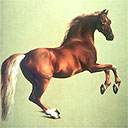
   Until I saw the Renaissance bronze "Prancing Horse" modelled by Giambologna (of which this is  detail) the only image of a horse that I'd ever been thrilled by was George Stubbs's "Whistlejacket,"
at the National Gallery in London.   "Whistlejacket" painted in 1762 is an enormous 292x246 cm. --colossal for an 18th century portrait. Yet standing before it, I accept without thinking that such a giant-sized canvas was needed in order to do justice to majesty and high spirits of this beautiful creature. I might feel scared of such a beast up close and in person but in the gallery I look at Whistlejacket and feel nothing but joy. I just stand there and smile.
   Two days ago I visited "Renaissance and Baroque Bronzes from the Hill Collection," which has just opened at the Frick in New York. On view are 33 bronzes from the Collection of Janine and J. Tomilson Hill. Mr. Hill is big in money (Vice-Chairman of the Blackstone Group). He collections paintings also. Three of them--two by Cy Twombly and one be Ed Rucsha are also on view--a first showing of contemporary art for the Frick.  By Mr. Hill's reckoning, he is one of about 15 major bronze collectors world wide--"major" defined as people who can spend $3 million or more on a single piece. More importantly for this viewer, he appears to have a good eye and good advice. There are many fine and lively works; some French, a few German but most Italian. To my surprise (I am doggy not horsey) while I admired and enjoyed many of the bronzes, I fell for the "Prancing Horse." Cast around 1573, it is 25.1x28.7 cm. -a statuette and a midget compared to Whistlejacket. Yet it is every bit as arresting. The whomph it packs is different however; it is not the power of joy but rather the power of tenderness. The show is terrific and this prancing pony is its star.
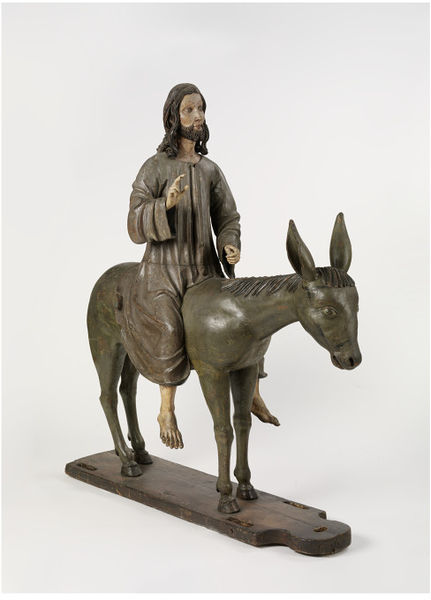
  Now about another two ears; the baddies.  Not far from the Frick, at the Richard Feigen gallery, London dealer Sam Fogg is staging "Wonders of the Medieval World." Among the objects on view is a carved wood, painted "Palmesel" or figure of Christ on a donkey. Such a statue (here as in many others, the figure of Christ is about the size of a 8 to 10 year old) was pulled through the street on Palm Sunday; it represents Christ's triumphal entry into  Jerusalem. This honey of an example is in the collection of the Victoria & Albert Museum in London. (An image of Fogg's proved elusive.)
  The trouble with Fogg's version was the donkey's ears. The problem wasn't that they are clearly replacements. It is a good thing to make plain what is original and what is not. The difficulty was that these large pointy substitutes were wooden; not as in made of wood but as in lacking soul. I was standing alongside the piece thinking about the expressive, touching ears of Giambologna's horse when Sam Fogg strode up in the company of another man.
  "Larry thinks these ears are distracting and should be removed, what do you think?" Sam asked me. Larry I later learnt is  Lawrence W. Nichols Senior Curator of European & American painting and sculpture before 1900 at the Toledo Museum in Ohio. Larry could have been reading my thoughts so I had no difficulty saying that I agreed. Evidently this was a casting vote (or a flourish of showmanship).  Sam gave a gentle tug; the ears came off. He slipped them under the pull- toy like platform on which the Palmesel stands. A big improvement. 
  Two magnificent memorable ears are all New York needs to celebrate the start of the Year of the Horse in the highest possible style. Happy New Year.


Monday, 13 January 2014

Come hither City boys


The Museum of London invites us to "Discover the city of London and its people."  It does not deliver. Should you actually find your way to the vile seventies building on a roundabout in the City you won't see an entrance. That requires another hunting expedition. Hidden inside other buildings on the "mainland" are stairs and escalators to take visitors up to walkways which are open to the wind and rain. When you finally make it to the museum's actual entrance you sense immediately that everything has been done on the cheap. Even its logo is cringe- inducing. It looks like the winner of the booby prize in a first year, design school competition. Far more serious is the shocking fact that entire museum has a whopping total of four curators. They are heroic women and men, dedicated and hard working, but they are attempting to do an impossible job. The place is a disgrace to the city and the City both. Come on city boys and you women in finance, too. Use your expertise--and your dough--to create a museum we can all be proud of. It can be done. They've done it in Antwerp

 Visit the MAS (above). This exciting example of contemporary architecture is set in the old port's red-light district. The history and life of Antwerp is imaginatively displayed--its procession of elaborate model ships is thrilling-- something I had not imaged possible. The success of the MAS has led to regeneration of the entire neighbourhood.
    The Museum of London's collections include the 500 pieces of the Cheapside Hoard, the world's largest collection of Tudor and Jacobean jewellery.  Exceptionally all of it is on view for the first time in almost a century but most of it will go back into store in the spring when the current exhibition devoted to it closes. There it will rejoin  a million other objects--A million! Among these treasures are finds from Roman and Saxon London; artifacts of London's life as a major international port --and that means full-size boats. There are 24,000 examples of of  historic and contemporary clothing; impressive collections of tools, toys, paintings and photographs. There is street furniture and shop fronts and the entire archive of the Port Authority. Almost all of this is an all too well kept secret.
   There is no way to fiddle with the current museum. It is an architectural and geographic mistake. Yet, wouldn't you know that this is precisely what is being planned. The only approach that makes sense it to tear down the monstrosity and start again. Raze it and raise the dough to do it right next time around.

 Happy New Year to All


Tuesday, 26 November 2013

Catch up and go! 1.

There is nose to tail cooking and then, in my case, nose to concrete bashing. Not long ago, I tripped on my way into the Victoria&Albert Museum and I fell on my face, full force. Look no hands. This is one explanation for the gap in my posts. Fearing that the pavement would rise up and smash against me I nevertheless took my bruises and frog swollen mouth and nose to shows in London and, why stop there, in Florence and Amsterdam. At least the kind of art I go to see can't see whose looking. So this is my first catch up post. There's lots of time left to see them all.

Opal, ruby and opalescent quartz scent bottle
The Cheapside Hoard at the Museum of London. (read what I wrote in The Economist published October 12 ).  Here I will just say that this is the first time since the hoard was found in 1912 that all of is on view. There are  500 jewels, gems and luxury objects --among them a little enamelled gold watch set in a pretty big and very beautiful bluey green emerald.

This is the largest collection of Elizabethan  and Jacobean jewellery anywhere and it is extremely well displayed. The story of the discovery and of the sometimes dodgy practices of goldsmiths in 16th and 17th centuries --ignoring the law among them-- is vividly told by curator Hazel Forsyth in "London's Lost Jewels" which complements the show. (There should be but there is not a catalogue with images and descriptions of all the objects.)  One of the prettiest pieces is the enamelled gold, opal and ruby scent bottle at the top. One of the most fascinating is the what remains of a watch made in Geneva probably between 1610 and 1620 signed by Gaultier Ferlite. The makers of all the other objects in the horde remain unknown. Forsyth has dated to the burial of these treasures to sometimes after 1640 and before the Fire of London in 1666