Friday, 26 August 2022

Milton Avery at the Royal Academy --what a surprise; what a treat


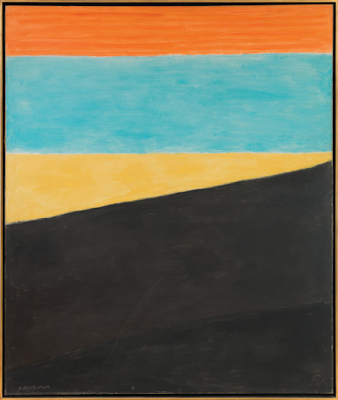
 Cheery colors, flat surfaces, simplified shapes....in those years when I often walked in and around Washington Square Park in the Village I often had a look at paintings by Milton Avery. The gallery that showed them was on a corner and down some steps; its windows were not far above street level. You had to look down on them to see them. And so I did, in both senses of the word.   Very pleasant, I'd think. Very not much else.  Boy was I wrong. I walked through the current exhibition devoted to him at the Royal Academy in London and was wowed over and over again.


                                                                 Self-Portrait 1941

   So a few facts about him and then a series of pictures:

Avery was born in New York State in 1885 and died in 1965. His grave is in the Woodstock, NY artists Cemetery. (I confess that I lived in Woodstock and didn't know it had one! Although it sure had plenty of artists--actually or in name only.) I learn from the RA catalogue that he was represented over the years by a number of prestigious, uptown galleries: Valentine Gallery, Paul Rosenberg&Co, Durand-Ruel, Grace Borgenicht.


A painter who was "on the scene" in the Village, Provincetown and Woodstock but also Key West which I associate more with Tennessee Williams and Hemingway than with painters..we see Avery at the start transfixed by the Impressionists. And then he is on the move going his own way. It was a trip that took him so far into the pleasures of color that by the end it was Avery who was influencing the Abstract Expressionists and Color Field painters.  It is said that he was "a man of few words" and maybe that is why he wasn't better known in his time. Well that is for another kind of writer to write about. My message is short and sweet:

Go to this show if you can: Enjoy it; be surprised; look, learn a thing or two and be wowed.  


                                                       \Setting Sun    1918


Chariot Race   1933
[A wild, wildcard]


Seated Girl 1944


                                                           March in  Brown 1954
.                                         

                                               Boathouse by the Sea   1959

Friday, 27 May 2022

The Burrell renewed but not improved


The Burrell Collection, closed in 2016 for expansion and renovations, is now open again.  I just visited Glasgow and headed for it, my favorite place in the city.   

First the good news:  


Art and nature remain companions; sometimes tender sometimes harsh; there's a lot of weather in Scotland. 


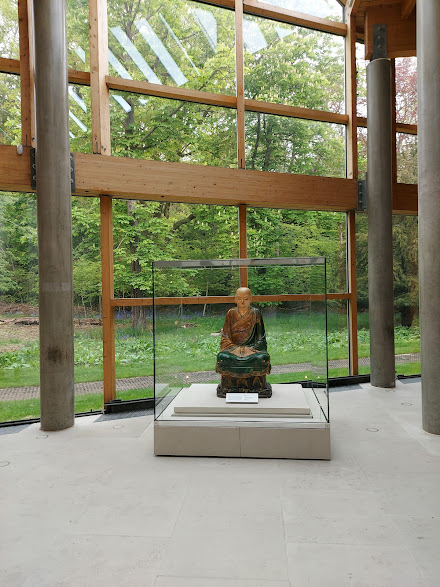
This Ming Luohan who has been sitting cross legged since he was carved in China in 1484 and who has done likewise at the Burrell since its opening in 1983, remains the centerpiece of the much loved glass- walled highlights gallery were the backdrop for the works on view is grass, wild flowers and trees.


More space has been opened up above and below the main floor. Almost twice as many art works are on view. The velvet rope is gone; we can walk into the recreation of a grand room in Hutton Castle the home of Sir William Burrell (1861-1958) and housed his collection of some  9,000 works from ancient art to the late 19th century; from Chine to Europe. 

  The shop is imaginatively stocked; downstairs and with a tall glass wall of its own, was busy.  (Near the entrance there is space for thsoe who just want tea, coffee, scones. The upstairs galleries focus on materials and craft: lace making, stone carving and such. Newly accessible below, is a special exhibition space and the collection store. 

  Even this is the good news only relatively. For example: In the recreation of a room at Hutton Castle, we find jerky films pretending to be candid glimpses of Sir William at home. Phooey. And that is only the beginning of the "reimagining" of the Burrell. Its transformation from an art museum to a building that is intended to be a heart warming, fun day out.


The art is there to tell its own story. 


If only it were left alone to do so.

 Instead the collection has been rehung according to themes; themes suitable for kiddies. One room is Animals; another Gardens, a third is called Flowers. In Flowers, for example, anything with one or a bunch is put together whatever the period, material, conception. And to make it still more attractive--and muddled-on one large flower filled wall a looped video provided an unending cascade of falling petals. So pretty...so maddening.


How did we get here?  A place where this great museum and too many others are now run people who have no feeling for, who act as if they are afraid of it and what harm it might do.  So I end with this image of a chess piece from Sir William's collection. 

    Off With Their Heads!!!!   But honestly, it's only a lump of bone. 


Sunday, 26 September 2021

Duncan Grant at Charleston Farmhouse: An exhibition of paintings buried in myths and and rescued by them


The Room with a View 1919


This picture, radiant with light and joy, was painted by Duncan Grant (1885--1978), in the first spring following the Armistice. More intimately--and directly-- it  celebrates baby Angelica's survival. Shown here with her mother in the garden beyond the studio, Angelica, who was born on Christmas day, had been sickly but now robust good health had come at last. It is one of 30 paintings now on display at Charleston Farmhouse in East Sussex (until 23 March). They revisit Grant's first ever one- person show at the Paterson-Carfex Gallery in London and mark its centenary. (It is in fact a centenary +1 as a result of pandemic restrictions.). If asked the well worn if somewhat lamebrained question: "What work would you take home if you could?" I would shoot back: "The Room with a View."  In a beat I would have second thoughts: The idyllic vision that draws me to the picture is part of what makes it, also disturbing. 

We now, what those who visited the Paterson-Carfex in Old Bond Street more than 100 years ago did not,  that the artist was in fact the father of that baby girl. He had had a brief affair with her painter mother, Vanessa Bell, shown here holding the infant on her lap. Mom was married to the art critic Clive Bell;  Grant's lover was the writer David Garnett. All lived together at the remote farmhouse during the war,   Vanessa did not tell her daughter the name of her biological father until Angelica was in her late teens and then added that it was best  not to discuss this with either of her dads.  Evidently she kept her mouth shut.  At 23,  Angelica married David Garnett. No one chose mention that he and her father had been lovers and, indeed  had been lovers at the time she was born. Let's leave the saga here with an "etc. etc." 

It is not hard to imagine that  Duncan Grant chose the title for this painting as a reference to EM Forster's "A Room with a View." That novel published 11 years earlier was like a loosening of moral corset stays; encouraging people to freely follow their feelings; their desires-- whatever the wishes of those close to them; whatever the gender of the person to whom they were attracted. The household that went on to become famous as Bloomsberries, certainly gave that a go. 

Vanessa Bell and Duncan Grant painted the rooms of Charleston and much of its furniture; fabrics were designed for Roger Fry's Omega Workshops The 48 "Famous women," dinner plates painted by Bell and Grant to a commission from  Kenneth Clark have now come back to Charleston and serve as an engaging welcoming committee to visitors entering the house. Who the artists chose and how they chose to paint the portraits gives the onlooker plenty to think about that happily has nothing to do with the myth of their carryings on in and out of bed. The farmhouse has been tenderly looked after and even for somebody (me! who does not fancy a house decorated with Bloomsberry tablecloths and a ceramic colander as a kitchen lamp (the work of Quentin Bell), it is a lovely place to visit. 

 Their emotional and sexual relationships-- tangled and deceitful to themselves and one another-- have become more famous than the works of the artists and writers who made their home at Charleston Farmhouse. Indeed interest in their carryings on has helped keep their works alive. That is not a bad thing. I am very glad to have gone to this Duncan Grant centenary exhibition and especially to have met "The Room with a View." I am charmed by  Charleston Farmbouse. The cafe has very nice food.  I enjoyed myself --even the cows I saw from the train window looked delightful. Yet I came home feeling that,  individually and collectively, whatever their artistic gifts, these Bloomsberries were coated in something sticky and not beautfully scented.    

 It may be a cheap shot; it may be a non sequitur. but I can't not end without this: Vanessa's sister and near neighbor Virginia Woolf always gives me the impression that she would recoil if someone reached out and touched her. Rodmell, over the downs, where she lived with her husband Leonard, is quite nice to visit but in itself it would not mean much had it not been the home of one of the great 20th century writers. It is her work that drives interest in her life; not the other way around. But no, this is not a advertisement for repression. Just one of those curious facts of life or lives.


Monday, 5 August 2019

art darts: Helene Schjerfbeck--See this great show; as for he...

art darts: Helene Schjerfbeck--See this great show; as for he...: Helene Schjerbeck Self-Portrait 1915 A friend in Haarlem  commanded me to go to the Geementemuseum in the  Hague and see an exhibitio...

Helene Schjerfbeck--See this great show; as for her name--just forget the j and it is easy to say

Helene Schjerbeck Self-Portrait 1915


A friend in Haarlem commanded me to go to the Geementemuseum in the  Hague and see an exhibition of paintings by Helene Schjerfbeck. That was 11 years ago. Ruud  has a terrific eye and is not given to pronouncements of this kind. On the contrary. I got it. This was important. I went. It certainly was and is. I had never heard of her. She has not become widely famous since. She ought to be. Schjerfbeck (1862-1946) has been justly famous in Finland since she was in her teens. From the point of view of the rest of us, art news from a country with a population half the size of London or New York does not travel even at a snail's pace--especially when most of the artist's work is in museums and therefore lacks the drive of dealers to make reputations/money.  Let's hope that with the current exhibition at the Royal Academy in London will change this.  Whether it does or not, do not miss the show if you possibly can see it.  You are not likely to soon have another chance to see her work; to see so many memorable, touching and beautiful paintings. 
 The 2008 show in the Hague had travelled from Hamburg and was on its way to the Museum of Modern Art in Paris. The story about the artist which I wrote for The Economist was published to appear when the show in Paris opened.  It was better done in the Netherlands where in one large space was devoted only to her self portraits arranged chronologically. The RA has done the same. For these alone a visit to the London show  is more than worthwhile  Let's hope that New York, Washington, Boston, San Francisco wake up.                                                                                                                                                           
 What follows. Alas the print is too small but I remain technically challenged and cannot work out how to enlarge it without making running over the margins. For you it will be easy. An do not hesitate to send me message if you wish to educate me about how to make the post easier to read. Please.


Monday, 13 May 2019

When everything's Camp, nothing is or very nearly

"Camp: Notes on Fashion:" the Metropolitan Museum of Art's Costume Institute show that opened on May 8 is full of color and feathers and already a big hit.  It's like a day at the circus for more- or- less grown ups; a circus where frocks and accessories are the performing animals sometimes literally. The Schiapparelli hat to the right looks like Big Bird taking a couple of flamingos on a honeymoon trip.

 For any who remember what it feels like to eat too much cotton candy; that's just how I felt by the time I'd walked through this exhibition from beginning to end. 

In spite of the pink catalogue's thousands of words that attempt to define it, and an opening historical section that is well- worth reading, full of unknown to me information (and images),  Camp as it is on display in these galleries gives shelter to a lot of extravagant frocks-- and some witty ones-- along with a few accessories. Most of it has a dubious connection  to Camp (see the Tiffany lamp below) .

The curators, of course, do not find the connections dubious: Take for example, The Tiffany lamp below. Susan Sontag, who we are told (as if this is somehow miraculous, used to visit the Met regularly) included it in her famous essay on Camp. If you think Sontag was a latter-day Moses and her essay consists of  58 commandments, you will agree. 

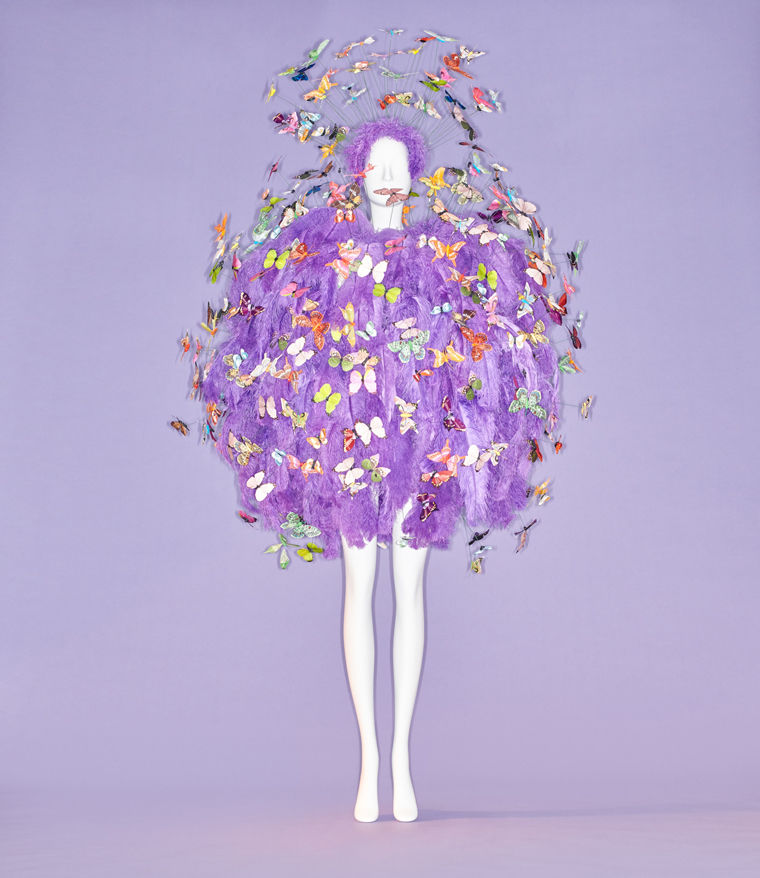
The actual criterion for what made it into this show was the stuff had to be Over the Top as for butterflies everywhere but in the stomach number by Jeremy Scott for House of Moschino. (I am a big fan of Moschino and not only because he chose Olive Oyl for his muse  .Fun yes, whacky also but Camp?Couture ensemble of purple feathers adorned with bejeweled butterflies


OTT is not Camp,  or let's say it is can be a part but the whole? Not. So anything from a dress with a Merry- Go- Round for a skirt and a frock embroidered with a Surrealist image by Jean Cocteau is classified as Camp but is not.

 Too much sugar is bad for the brain--and other important organs as for instance, the eyes. This show--and the gala that opened it is an advertisement for Enough is Too Much already.  

Thursday, 2 May 2019

Frends in Zen:: Isamu Noguchi and Saburo Hasegawa


It was a friendship that changed the thinking and the art of  Isamu Noguchi (1904--1988) an internationally famous sculptor and garden designer and Saburo Hasegawa (1906--1957) then celebrated but now a forgotten figure.
They met in Japan in 1950.

1-Saburo-Hasegawa-and-Isamu-Noguchi-at-Shisendo-Temple-Kyoto-1950---photo-Michio-Noguchi - The Noguchi Museum Archive..jpg
 "Changing and Unchanging Things: Noguchi and Hasegawa in Postwar Japan," the exhibition that just opened at the  noguchi museum in Long Island City tells the story of how their contact in few years that followed inspired and shaped their ideas and their work.  The curators also seek to demonstrate that Hasegawa deserves an important place in the history of midtwentieth century art not only because of the influence he had on Noguchi but on Franz Kline and others including Jasper Johns.  The sculpture, calligraphy, screens, paper lanterns, woodcuts and ceramics on view are often arresting, frequently beautiful and ultimately unnervingly moving. In spite of the curators' passionate appreciation of Hasegawa's work, they fail to convince us of his lasting importance. Yet his late, powerful works, one of which closes this show, more than hint of greatness. Perhaps an exhibition devoted to his work alone is be needed to do him justice. Happily, even if they have failed in one of their ambitions, they have succeeded brilliantly in showing us the impact of the friendship as they struggled with how in what ways East and West might be in conversation. It is an exciting, instructive exhibition.


Hasegawa led Noguchi on a trip across Japan to some of its most venerated gardens, shrines and temples, The influence on Noguchi's work is clear (see "Garden Elements, 1958),left. In their conversation and their work they attempted to explore ways to reinvigorate Japanese culture after the destruction and fragmentation of the Second World War as well as finding ways of bring their two cultures together (Noguchi spent most of his life in the United States although there were periods in his childhood when he lived in Japan). Perhaps perversely,  it was Noguchi who believed that Japan must not dilute its traditions by incorporating too much from the West; a view Hasegawa did not share. Below is a Noguchi piece showing the influence of traditional museum.

N-S-4_00492_Garden_Elements.jpg


 Here Hasagawa takes traditional calligraphy and turns it into a work that allied him with the New York School abstract Expressionists.


Hasegawa moved with his family to San Francisco. A heavy smoker he was diagnosed with mouth cancer. Many of the mural scale works he created as his illness progressed were on wall board and have not survived. One has only as a photographic record. It is a folding on 10 foot tall wall boards; used a broom as his brush. It quotes Basho's Death Poem:  
Sick on my journey, 
only my dreams will wander      
these desolate moors.

The calligraphy which gives the work its title of "Pure Suffering," using ink on burlap is the only surviving large, late work by Hasegawa,  It closes the show. It is reason enough to cross the East River from Manhattan to visit this show.

Saburo-Hasegawa-Pure-Suffering-1956-Ink-on-burlap-Private-collection.tif

PURE SUFFERING (1956)  30 x 96 inches